Practical Omnichannel Retail Integration Strategies (And Why Most of Them Are Already Broken)


Somewhere in your company's Google Drive, there is a slide deck. It has a title like "Omnichannel Transformation Roadmap" or "Unified Commerce Vision FY24." There is a diagram with your brand in the middle and channels radiating outward like a very confident star. Someone presented it to leadership. Everyone nodded. There was applause, or at least the meeting equivalent of applause, which is people closing their laptops and saying "great work."
That deck is probably lying to you.
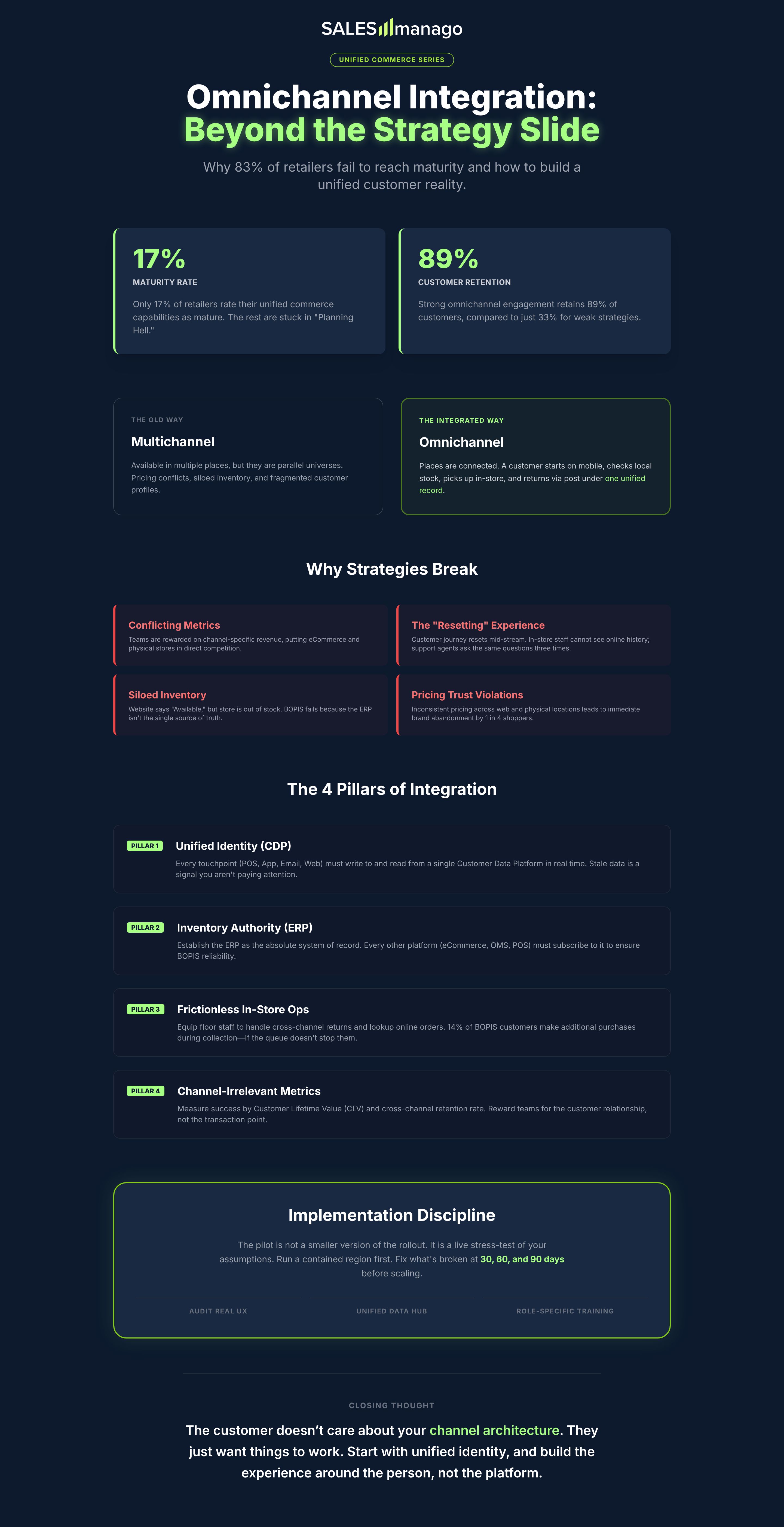
According to research from Manhattan Associates, only 17% of retailers rate their unified commerce capabilities as mature. That means 83% of the industry is either stuck in the planning phase, running a partial implementation they've decided to call finished, or watching the gap between their strategy slide and their actual customer experience quietly widen every quarter.
This is not a guide about how to build the deck. It is a guide about how to make the deck come true (like an omnichannel Fairy Godmother) and about the specific, avoidable ways retailers break their omnichannel integration before it has a chance to work.

Every post-mortem on a failed omnichannel project reads the same way. The technology wasn’t perfect, but it wasn’t the technology’s fault. The budget was tight, but money wasn’t the real problem. What actually happened was much more predictable: the organisation agreed on a word without agreeing on what the word meant, and then spent 18 months building the wrong thing very diligently.
Omnichannel retail integration means your sales channels, marketing communications, customer data, inventory, fulfilment, and support all run from a single shared picture of the customer. Not separate pictures that occasionally compare notes. One picture. When someone switches channels mid-journey, nothing resets. No repeated explanations, no conflicting prices, no “sorry, the website and the store are different systems”, a sentence that should be retired from retail permanently.
Before buying any technology, write one sentence defining what success looks like. Not a vision statement. One sentence, specific enough that you could use it to settle a disagreement in a meeting. Something like: “A customer can start a purchase on any channel and complete or return it on any other, with consistent pricing, stock visibility, and service at every step.” “Omnichannel” is a word that can absorb almost any definition without complaint. Vague mandates produce vague implementations.
Here is the failure mode that no one puts in the post-mortem report, because the people writing the report were part of it. Omnichannel projects die when different parts of the organisation are measured on metrics that put them in competition with each other. The eCommerce team is rewarded on online revenue. The stores team is rewarded on store revenue. The eCommerce team launches a flash sale without telling the stores. The stores team discourages click-and-collect because it doesn’t count toward their target. Everyone hits their individual numbers. The customer experience is quietly fractured.
To avoid these predictable failures, successful omnichannel retail integration strategies must address organisational silos and misaligned incentives by ensuring all teams are aligned on shared goals and metrics.
The fix is not a better project plan. It is metrics that make the channel irrelevant. Customer lifetime value, cross-channel retention rate, CSAT across all touchpoints: these measure the customer relationship, not the channel that got credit for a given transaction. Get them agreed at exec level before the project starts. If you can’t get that agreement, the project is not ready to start.
Multichannel means you're available in multiple places. Omnichannel means those places are connected. The gap between those two sentences is where most retailers are currently living, convinced they're doing the second when they're doing the first.
A multichannel retailer sells in-store and online. An omnichannel retailer lets a customer check online whether their size is in stock at their nearest store, pick it up that afternoon, and return it via post three weeks later, and all tracked under one profile the store associate can pull up when the customer walks in with a question. The distinction has nothing to do with the number of channels. It is entirely about whether those channels share data and operational rules, or whether they are politely parallel universes that happen to carry the same logo.
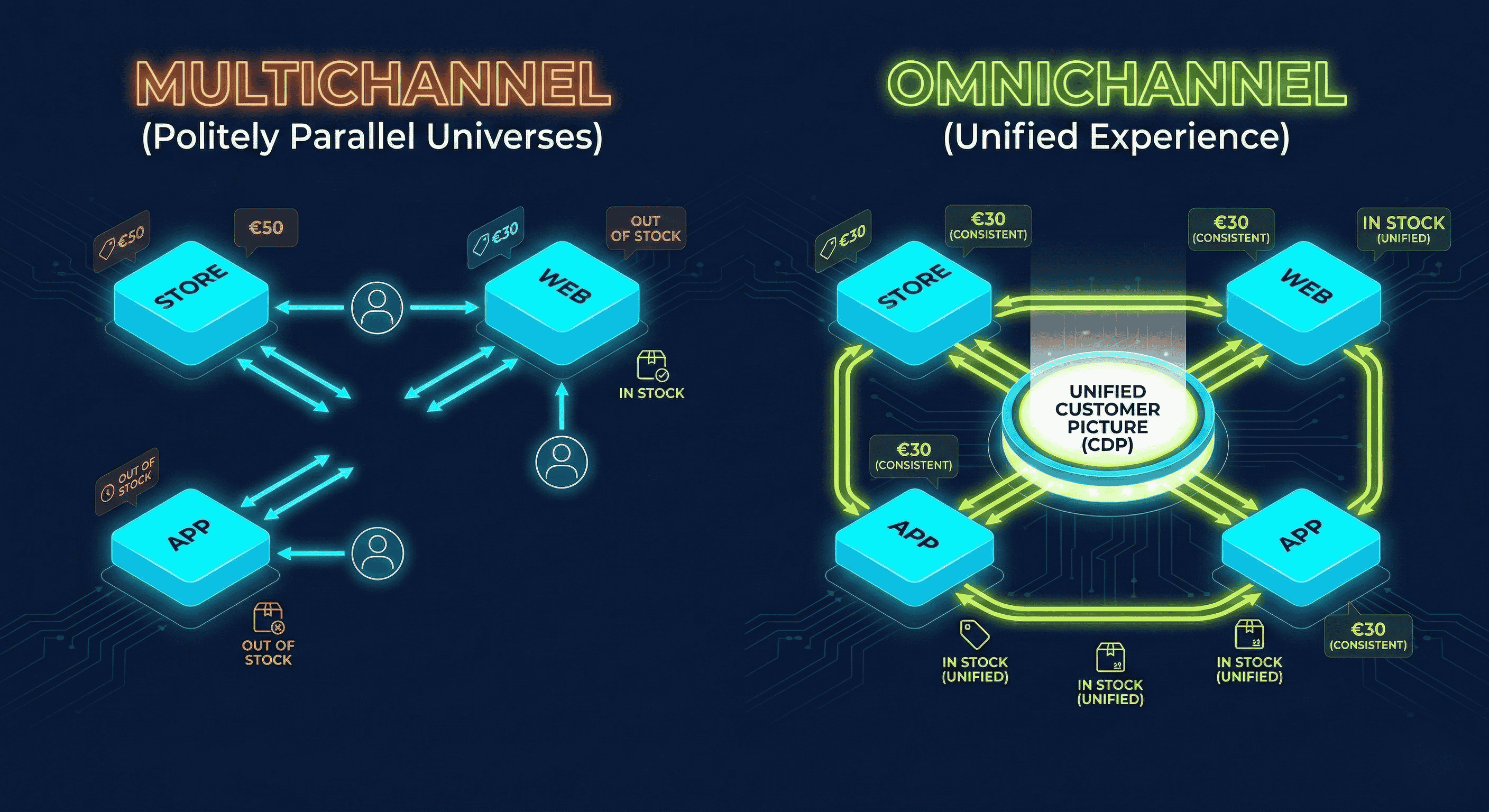
Before any integration work, conduct an honest audit of what's broken. Not the theoretical capability map. The actual customer experience, walked through as a real customer would walk through it.
Buy something online. Try to return it in store. Call customer service about an order you placed through a different channel. Note every moment the experience resets, contradicts itself, or requires you to start over. Each one of those moments is a silo in your data architecture made visible.
Common findings in retailers who have convinced themselves they are omnichannel:
CRM and POS in separate worlds. In-store purchases aren't attributed to the customer profile. Win-back campaigns firing at people who bought yesterday. Loyalty tiers invisible to store staff.
Email and on-site personalisation not talking. A customer who unsubscribes from marketing emails is still getting behavioural popups on the website the next day.
Per-channel inventory systems. The website says available; the store says out of stock for a week. The customer who drove to collect it will remember that.
Promotional pricing running on different rules per channel. Staff hearing about online promotions from customers, not from their own comms.
None of these are exotic failure modes. They are the standard state of most mid-market retail operations, dressed up in strategy language.
Most retailers think they know how their customers shop. Then they pull the data and find out they’ve been wrong for years about which customers are worth the most, which channels actually drive purchase decisions, and where the journey breaks down.
Run the simple analysis first: what percentage of your customers buy exclusively online, exclusively in-store, and across both channels? How does average order value compare? How does 12-month retention compare?
Cross-channel customers are almost universally the highest-value segment. Higher CLV, lower churn, stronger brand affinity. Most retailers know this in theory. Fewer have let the implication actually land: if cross-channel customers are worth significantly more, then the single most commercially valuable thing you can do is make it easier for single-channel customers to become cross-channel customers. The whole integration strategy follows from that. It's essential to recognise that each customer's journey and preferences are unique, so your data analysis and integration strategies should reflect this individuality.
If you’re not tagging purchase channel in every transaction, you are operating blind. Fix that first. It costs almost nothing to implement and produces the data that justifies everything else in this guide.
Behavioural data shows you what customers do. Zero-party data, information they volunteer directly, shows you what they prefer. These are different questions and they produce different answers.
A short post-purchase survey asking customers which channels they prefer for browsing, for communications, and for returns costs almost nothing and produces intelligence nobody else has, because customers chose to give it to you. A Customer Preference Centre built into your CDP is the infrastructure for this at scale. Use what you collect to segment and personalise communications rather than defaulting to the same message for everyone.
Keep surveys to three questions. A customer who just spent money with you doesn't owe you eight minutes.
The retail industry has spent decades collecting customer data. Most of it is sitting in silos, stale, or being used to send the same promotional email to everyone regardless of what they've done, bought, or told you they want. Collecting customer data is not the achievement. Using it in real time to change what a specific customer sees and hears, that is the achievement, and it is where most brands still fall short.
Every channel interaction should write to a single customer record: web sessions, email activity, in-store transactions, app usage, customer service contacts. When a customer walks into a store, a well-equipped associate should be able to see that this person browsed running shoes on Tuesday, has €120 in loyalty points, and last bought in-store six weeks ago. Not theoretically. Actually.
This requires a Customer Data Platform, a system that aggregates behavioural, transactional, and declared data from all sources into one real-time profile. Without it, personalisation at scale is just segmentation by guesswork. The real-time requirement matters more than it sounds. A customer who just bought in-store should stop receiving emails for the product they just bought. Stale data doesn't just miss opportunities. It actively signals to the customer that you are not paying attention.
Personalisation is not the same message on every channel with someone's first name in the subject line. It is the right offer, on the right channel, informed by what you actually know about this person. Someone who shops predominantly in-store and has never bought online might respond to an email offering an in-store exclusive. An online-first customer who has never visited a physical location might respond to a click-and-collect offer that removes the barrier. Someone who spent €600 in the past 90 days gets different treatment than someone who last bought 18 months ago and is quietly lapsing.
RFM segmentation, Recency, Frequency, Monetary value, is the right starting point if you're not already doing behavioural segmentation. It requires no complex modelling, it uses data you already have, and it produces immediately actionable audience splits.
This is where everything you've built in the back end either shows up as a coherent experience or betrays itself in small, damaging moments. Customers don't read your integration roadmap. They notice when the price is different online. They notice when the product looks different in person. They notice when the checkout has seven steps on mobile. And they leave.
More than one in four shoppers have abandoned a brand after a frustrating cross-channel experience. Inconsistent pricing is near the top of the reasons why. Finding an item cheaper online while standing in a store with it in your hands, or paying full price in-store and seeing a flash sale launch two hours later, are not minor inconveniences. They are trust violations that customers remember and talk about.
Pricing and promotions need to be managed from a single source of truth, your ERP, your PIM, or your eCommerce platform, with real-time push to every channel. The harder part is governance: who owns the pricing rules, who has authority to run channel-specific promotions, and how does that information reach store staff before customers arrive with their phones showing a different price.
The same logic applies to product information. A customer who reads "slim fit" on your website and finds the garment labelled "tapered fit" in-store will hesitate. One who sees studio-white photography online and finds something more ecru in person is going to return it. Product descriptions, specifications, and images should originate from one source, a PIM system, and distribute to all channels from there.
Over half of eCommerce traffic is mobile. Conversion rates on mobile still lag desktop for most retailers by a margin that should be embarrassing. The gap is almost always checkout friction: too many form fields, slow page loads, payment methods that weren’t designed for a screen you hold in one hand on the bus.
Count the taps in your mobile checkout. Test it on a mid-range Android on a 4G connection, not a new iPhone on your office Wi-Fi. Offer digital wallets as the first-choice payment option. A checkout that works on mobile is consistently one of the highest-return technical investments a mid-market retailer can make, and consistently one of the most deprioritised. Optimising mobile checkout is essential to reduce friction and prevent customer drop-off, get it sorted.
BOPIS and cross-channel returns are where omnichannel integration either earns its budget or reveals that the strategy never made it past the PowerPoint. The failure modes here are not abstract. They are a customer arriving to collect an order that isn’t ready, or a store associate who cannot process an online return without calling a manager. These moments happen thousands of times a day at retailers who believe they have solved this problem.
BOPIS works under four conditions: stock is accurately reflected online, fulfilment is fast, the collection experience is frictionless, and staff know what to do. It fails when any of those four conditions isn’t met, and in most implementations, at least one of them isn’t. Overselling a BOPIS order, you know, like confirming collection and then calling the customer when the item isn’t actually there, is an operational failure that the customer will not forget. When the process works, 14% of BOPIS customers make additional in-store purchases during collection. “When the process works” is the operative clause.
Cross-channel returns are one of the simplest ways to increase online conversion and one of the most under-invested areas in mid-market retail. Nearly a third of online shoppers say they are more likely to complete a purchase if they can return to a physical store. Your returns system needs to accept online orders in-store, sync back to the customer profile and inventory immediately, and be something every store associate can handle without escalating. Customers who arrive to return something in-store buy something else 30-40% of the time. A cold, friction-heavy return process forfeits all of that.
A store associate who can pull up a customer’s order history, loyalty tier, and online behaviour is a fundamentally different kind of salesperson than one who can only see the stock in front of them. During a customer’s visit, a personalised greeting and integrated service reinforce the connection between online and in-store experiences, making the in-store visit a key moment for omnichannel retail integration strategies. Most retailers have the data to make this possible. Most of them haven’t wired it to the people on the floor who could use it.
Every omnichannel strategy deck shows channels feeding into a central data hub. Clean arrows, elegant circles, unified data flowing effortlessly in all directions. This section is about what actually has to happen behind that diagram, and what breaks when it doesn’t.
A CRM manages customer relationships and records interactions. A CDPdoes that and also unifies raw behavioural data from every digital touchpoint in real time, making it available for segmentation and activation across all channels. For mid-market retailers trying to do serious omnichannel work, a CDP is typically the right infrastructure layer. The requirement is non-negotiable in both directions: every channel must write to it, and every channel must be able to read from it. A CDP that only integrates with your email platform is not a CDP. It is an expensive contact list.
Your POS and your eCommerce platform need to share transaction data, customer identity, and inventory updates without exception. Without them, in-store purchases are invisible to your online marketing, customer profiles are permanently incomplete, and inventory is out of sync. Modern POS systems have API integrations. A unified commerce platform can integrate ecommerce, POS, inventory, and customer data, eliminating data silos and enabling real-time synchronisation for a smoother customer experience.
Point-to-point integrations work for two systems. They start groaning under the weight at four. As you add channels, a middleware layer that manages integrations centrally holds the architecture together. Without one, every new channel requires custom development, every change has unpredictable downstream effects, and data quality becomes impossible to guarantee across the full stack. Evaluate middleware on native connectors, reliability SLAs, and the internal expertise you have to maintain it. The cheapest option rarely proves cheapest over three years.
Customer support is the most reliably siloed part of omnichannel retail because it doesn't appear in the customer journey maps that go into strategy decks. It is also the part of the experience with the most direct impact on whether a customer stays or leaves.
A customer who contacts you by email, follows up on live chat, then calls the store should not have to explain their issue three times to three different people with no record of the previous conversations. That experience tells the customer, more clearly than any branding decision could, that they are interacting with three separate businesses that happen to share a logo.
A centralised helpdesk pulls all contact channels into one view per customer. Every agent sees the full history. Handoffs don't reset the conversation. Connect this to your CDP and an agent handling a call can see the loyalty tier, the order in transit, the previous complaint, and use that information to resolve the issue faster and with more care. If a customer starts a chat on your website and switches to your app, the conversation should not restart. If they close the chat and email instead, the next agent should have context. Most modern customer engagement platforms support this. If yours doesn't, close the gap.
Short, channel-specific post-purchase surveys give you direct signal on where the experience breaks down. CSAT and NPS measured per channel tell you which parts of the journey need attention. The aggregate score is useful for a board report. The per-channel breakdown is where the actionable information lives.
Fulfilment is where omnichannel strategy becomes operational reality, and where the gap between the strategy deck and daily operations is most likely to be expensive.
Ship-from-store turns your store estate into a distributed fulfilment network and reduces delivery times for orders near a store. Retailers who have implemented it well report 27% lower fulfilment costs compared to centralised warehouse-only models. It also puts real pressure on store operations: staff need dedicated time for pick-and-pack, which competes with serving customers on the floor. Get the pilot right before scaling. The retailers who have struggled with ship-from-store almost all expanded too fast.
Your ERP is the system of record for inventory. Everything else, your eCommerce platform, your POS, your OMS, your customer-facing stock displays, should pull from it as the authoritative source. The failure mode here is familiar: multiple systems accreting over time, each claiming partial authority over inventory data, none of them fully in sync. Conflicts between inventory records are not a minor data quality issue. They are the reason BOPIS fails, the reason stockouts show as available, and the reason your customer-facing data cannot be trusted. Pick one source of truth. Make it the ERP. Let everything else subscribe.
The most useful omnichannel metrics follow behaviour across channels rather than within them:
Cross-channel customer rate: the percentage of customers interacting with more than one channel in a rolling period. The direction of this metric tells you whether your integration is working.
BOPIS conversion rate: also a proxy for whether your inventory data is trustworthy enough for customers to rely on it.
Return rate by channel: often reveals where product expectations aren't being set correctly at the point of sale.
Customer lifetime value by channel combination: cross-channel customers are almost always worth significantly more than single-channel customers. Retailers with strong omnichannel engagement retain an average of 89% of customers, compared to 33% for those with weak strategies. Make that calculation concrete for your own business.
Aggregate satisfaction scores mask where you're failing. A strong overall NPS can sit on top of a terrible in-store returns experience or a checkout that breaks on mobile. Measure CSAT and NPS by channel and by journey stage. Fix the lowest scores first, not the easiest ones.
The technology is half the job. A well-integrated system operated by people who don't understand it will underperform a less sophisticated system that people actually use correctly. This gap accounts for a meaningful portion of the 83% of retailers who haven't reached integration maturity.
Don't roll out to every store simultaneously. Pick one region or store cluster that is representative but contained. Run the full integration. Stress-test every flow. The pilot is not a smaller version of the rollout, it is a live test of your assumptions, and those assumptions will be wrong in ways you could not have predicted. An inventory sync that holds under normal load but fails during a sale event. A BOPIS process that works for large orders but breaks for single-item purchases. A training gap that only surfaces when something goes wrong on a Saturday morning. Document all of it.
Different roles need distinct training designed for what those people actually do, not a generic overview of the system with the job title changed at the top. Store associates need to know how to look up online orders and process cross-channel returns. Store managers need to understand fulfilment workflows and exception handling. Customer service agents need to know how to use the unified customer view without sending customers back to the channel they just came from. Generic training gets politely attended and then ignored.
Schedule a structured review at 30, 60, and 90 days post-launch. Look at the per-channel CSAT scores. Look at where BOPIS is failing and where it isn't. Fix what's broken before it becomes the accepted normal state of the system.
83% of retailers are not where they think they are on omnichannel maturity. Most of them have a strategy deck that says otherwise.
The retailers in the 17% didn't get there by finding better technology or hiring smarter people. They got there by being honest about the gap between the strategy and the operation, fixing the foundation before building on top of it, and treating integration as an ongoing operational discipline rather than a project that ends at launch.
Start with unified customer identity. Get pricing and inventory consistent across channels. Give store staff the data they need to do their jobs. Build from there.
The customer doesn't care about your channel architecture. They just want things to work. Every integration decision either moves you closer to that or it doesn't.



Google "what percentage of loyalty programs fail" and you'll get a wider range than the Andes (world’s longest mountain range for those of you who failed Geography). Depending where you read anywhere from 20% to 97%. That tells you two things. First, nobody really agrees on what "fail" even means. Second, quite a lot of loyalty programs aren&...

You’ve seen the slide before. You know the one with your brand in the middle, channels radiating outward like a proud little sun. Email, SMS, web push, social, paid ads, on-site personalisation, maybe a loyalty program if you're feeling ambitious. It says "

This month isn’t about being fooled by the next massive industry panic or buying into stressful, hyper-complex tech trends. Low-friction joy? Welcome to the era of Treatonomics.