Omnichannel Marketing Automation: The Strategy for Unified Growth

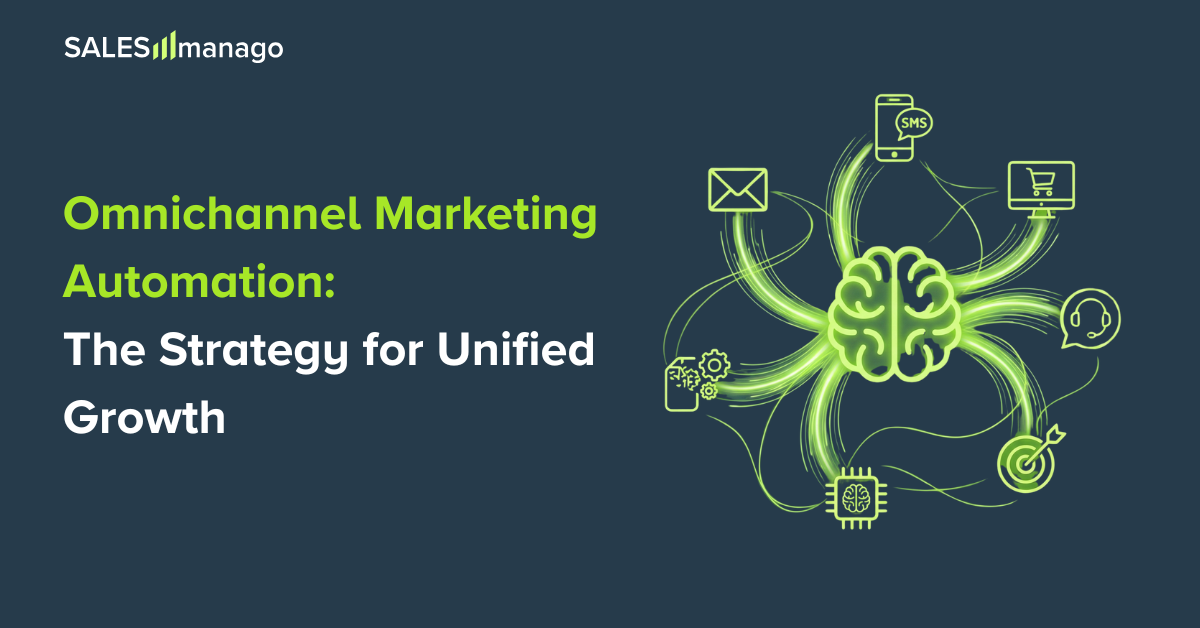
The modern eCommerce marketer is caught in a difficult paradox. You are expected to deliver a seamless, relevant experience for every single customer—true 1-to-1 personalisation—yet you are often armed with a fragmented stack of tools that treat your customers like rows in a spreadsheet.
To overcome this, you need to consolidate customer data from all digital platforms, such as your website, social media, SMS, and mobile apps, to create a unified view of each customer.
Currently, you might have an email platform for newsletters, a separate tool for SMS, a siloed system for customer support, and ad managers that don’t talk to your CRM. The result? A disjointed customer experience where a VIP shopper is treated like a stranger the moment they switch from their laptop to their mobile phone. Integrating these tools is essential to avoid data silos and enable a seamless customer experience across all touchpoints.
This is where omnichannel marketing automation becomes more than just a buzzword; it becomes the fundamental requirement for survival and growth in the European eCommerce market.

Before we talk about the basics, we must clear up some common misconceptions. Many businesses believe they are practising omnichannel marketing simply because they are present on multiple channels.
However, if you are sending emails, running Facebook ads, and offering SMS updates without a unified strategy, you might still only be doing multichannel marketing.
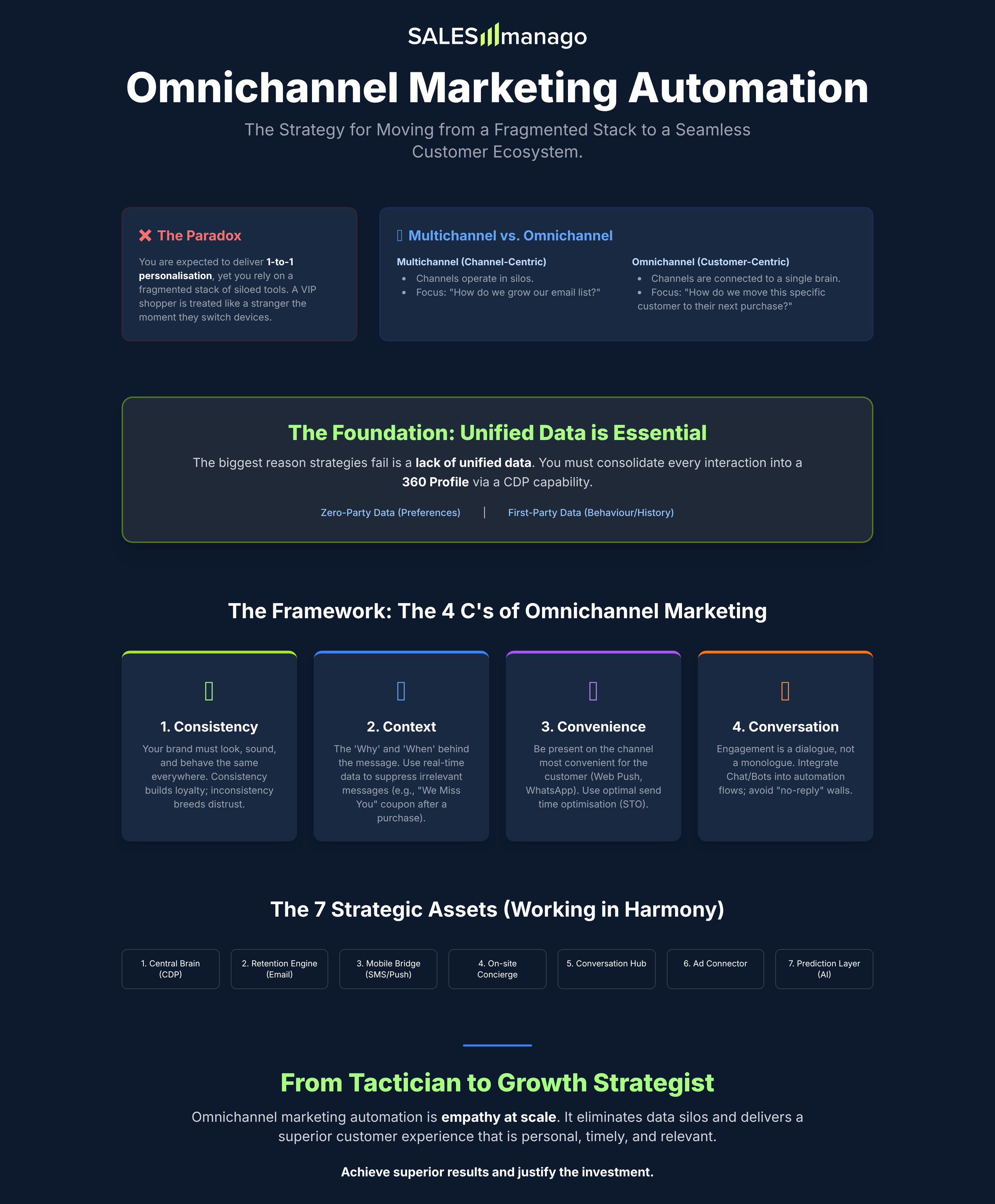
Multichannel Marketing is channel-centric. The strategy focuses on the medium: “How do we grow our email list?” or “How do we get more clicks on Instagram?” These channels operate in silos, often competing with each other and confusing the customer.
Omnichannel Marketing is customer-centric. The strategy focuses on the individual: “How do we move this specific customer to their next purchase?” The channels are merely the delivery mechanism, all connected to a single brain, making a customer-centric model possible through unified workflows.
Omnichannel marketing automation is the technological infrastructure that makes this possible. It is the ability to orchestrate a unified workflow where a customer’s action on one channel (e.g., viewing a product on the mobile app) instantly triggers a relevant reaction on another channel (e.g., a personalised email or a web pop-up), without any manual intervention. Ultimately, omnichannel marketing automation is essential for delivering a consistent experience across all touchpoints.
The first step in any successful omnichannel marketing automation strategy is to consolidate and analyse customer data.
The single biggest reason omnichannel marketing automation strategies fail is not a lack of creative ideas, but a lack of unified data. You cannot automate a relationship with someone you don’t recognise.
To achieve true personalisation, you must move beyond basic demographics by understanding customer behaviours and preferences. You need a Customer Data Platform (CDP) capability that consolidates customer data from every source:
Zero-Party Data: Preferences they have explicitly told you (e.g., “I am interested in Men’s Running Shoes”).
First-Party Data: Behavioural signals (clicks, views, time on site) and transactional history.
Only when you analyse customer data in a unified 360 profile can you stop blasting generic messages and start designing personal journeys.
If you search for “What are the 4 C’s of omnichannel?”, you will find many academic definitions. However, for practical reasons we define the 4 C’s as the pillars of a successful omnichannel marketing automation strategy. These four pillars are crucial for building an effective strategy that scales.
Your brand must sound, look, and behave the same way everywhere. Omnichannel marketing automation ensures that if a customer uses a discount code from an email, that code works instantly on the mobile app, and the banner on the website acknowledges that they have already claimed the offer. Inconsistency breeds distrust; consistency builds loyalty.
Context is the “Why” and “When” behind the message. Sending a “We Miss You” coupon to a customer who just made a purchase yesterday is a failure of context. A robust marketing automation platform uses real-time data to suppress irrelevant messages and trigger the right ones based on the customer’s current status in the lifecycle (e.g., Active, At Risk, Churning).
Automation can also wait for the optimal moment, such as pausing before sending a follow-up SMS or email, based on customer behaviour, ensuring messages are delivered when they are most relevant.
We live in an attention economy. Your customers are mobile-first and distraction-prone. Omnichannel marketing is about being present on the channel that is most convenient for them, not you. For some, that is WhatsApp; for others, it is a Web Push notification. Automation allows you to route messages to the channel with the highest probability of engagement for that specific user. It can also pick the optimal time and channel to send messages, maximizing engagement through features like send time optimisation (STO).
The era of the “monologue”, brands talking at customers, is over. Modern customer engagement is a dialogue. Conversational marketing tools help brands engage customers in real-time across multiple channels, ensuring interactions happen at the right moments and touchpoints.
This means integrating conversational marketing (Live Chat, AI Bots) into your automation flows. If a customer replies to an automation, the system must be smart enough to route that to a human agent or an AI assistant, rather than hitting a “no-reply” wall.
To execute this strategy, you need more than good intentions. You need a specific set of tools working in harmony. We identify these as the 7 Strategic Assets of a comprehensive omnichannel marketing automation platform.
These platforms offer key capabilities such as advanced personalisation, audience segmentation, and journey orchestration, enabling seamless and effective omnichannel campaigns. Activating all seven assets delivers significant advantages, including improved efficiency, greater flexibility, enhanced customer experience, and better decision-making for your business.
This is the heart of your operation. It is the repository where all customer data lives. Without this “Brain,” your marketing automation tools are just disparate instruments playing different songs. The Central Brain allows you to create dynamic segments, like “high spenders who haven’t visited in 30 days”, which update in real-time across all other assets. By tracking customer accounts, you can personalise engagement and segmentation based on each account's behaviours and preferences.
Email remains the highest ROI channel, but only if it evolves beyond “batch-and-blast.” As a core component of omnichannel marketing automation, email marketing plays a crucial role in creating personalised campaigns that integrate data from multiple touchpoints, ensuring a consistent customer experience across all channels. Your Retention Engine must support dynamic content—blocks of the email that change based on who is opening it.
Hint: A single email campaign sent to 100,000 people should look like 100,000 different emails, with product recommendations tailored specifically to each user’s browsing history.
Mobile channels are your bridge to immediate action. Integrating various channels like SMS, mobile push, and in-app notifications enhances the immediacy and reach of marketing campaigns. With open rates often exceeding 90%, SMS is a powerful asset for time-sensitive marketing campaigns.
Hint: Use mobile for “Flash Sales” or urgent “Back in Stock” notifications where speed is the primary value driver.
Your website should not be a static brochure; it should be a living environment. This asset uses marketing automation to change the website interface based on the visitor.
Hint: If a visitor is browsing "Winter Jackets," the homepage banner should automatically switch to feature your best-selling parkas, and a pop-up should offer a "Winter Guide" in exchange for their email address.
Following our acquisitions of Leadoo and Thulium, SALESmanago emphasises that support is marketing. The Conversation Hub connects your service team to the automation data.
Hint: When a VIP customer initiates a chat, the agent immediately sees their customer lifetime value and recent purchases, allowing them to offer a personalised upsell or a “thank you” gift. Personalised support in the Conversation Hub leads to higher customer satisfaction.
Your omnichannel marketing strategy must extend beyond your own properties. The Ad Connector syncs your CDP segments with ad platforms like Meta (Facebook/Instagram) and Google Ads.
Hint: You can automatically stop showing ads to customers who have already purchased the product. This saves budget and reduces advertising cost by targeting only relevant audiences, directly improving the customer experience.
Finally, the modern growth stack requires intelligence. The Prediction Layer uses AI to look forward, not just backward. It predicts customer behaviour, such as the likelihood of churn or the probability of purchase, allowing you to trigger automations before the customer even acts. AI can also help identify the potential of customers, enabling targeted outreach to those most likely to engage and convert.
Now that you understand the assets, how do you build the structure? To implement an effective omnichannel marketing automation strategy, you need to follow a series of steps that coordinate your efforts across multiple channels for maximum impact. A successful strategy is built in three phases.
Stop thinking in linear funnels. The modern customer journey is a loop. Map out the key touchpoints where value can be added and engage customers across different channels:
Discovery: social media, organic search.
Interest: website browsing, newsletter signup.
Consideration: cart addition, price comparison.
Purchase: transaction, delivery tracking.
Retention: support, feedback, repurchase.
You must ensure the customer journey can continue seamlessly as customers move between different channels. Identify where the friction points are. Where are people dropping off? That is where omnichannel marketing automation must be deployed.
Before building workflows, define your logic. We recommend using RFM Analysis (Recency, Frequency, Monetary) as a starting point.
Champions: Buy often, spend a lot, bought recently.
Loyal Customers: Buy regularly.
Hibernating: Used to buy, but haven't in a while.
Each of these groups requires a completely different omnichannel marketing approach.
Don’t try to automate everything at once. Start with the high-impact marketing campaigns that drive immediate revenue. Automation streamlines tasks that would otherwise require a manual process, allowing you to efficiently manage activities across multiple channels. Here are examples of omnichannel marketing workflows you can build today:
Example A: The Omnichannel Abandoned Cart
Instead of a simple email, use a cascading workflow to maximise recovery rates.
Trigger: Customer leaves items in the cart.
1 Hour Later (Email): Send a helpful reminder with the cart contents. “Did you forget this?”
24 Hours Later (Check Channel): Has the email been opened?
If YES but no purchase: Send a second email with social proof (reviews).
If NO open: Trigger an SMS with a short, direct link to the cart.
3 Days Later (Web): When they return to the site, show a personalised pop-up offering free shipping if they complete the order today.
To further optimise your omnichannel marketing automation, use A/B testing to compare different versions of your abandoned cart messages across email, SMS, and web pop-ups. By running A/B tests, you can determine which message formats, subject lines, or offers most effectively engage your audience. Measure the impact of each variation on CTR (clickthrough rate) to identify which approach drives the highest engagement and conversions. This data-driven method ensures you continually improve your workflow for maximum recovery rates.
Example B: The VIP Nurture Loop
Focus on customer lifetime value by treating your best buyers differently.
Trigger: Customer enters the “Champion” segment (based on RFM score).
Immediate Action (Email): Send a “Welcome to VIP” email with an exclusive unlocking of early access to new collections.
Ongoing (Web Personalisation): Permanently change their navigation bar on the website to highlight “VIP Offers.”
Special Occasion (Direct Mail/Mobile): Send a birthday wish via SMS and, if the value is high enough, trigger a notification to your team to send a handwritten note.
By leveraging targeted communications throughout this workflow, you can deliver personalised messaging that increases engagement and loyalty among VIP customers.
The complexity of managing these journeys across so many channels can be daunting for marketing teams. This is where Artificial Intelligence becomes your partner, not just a tool.
At SALESmanago, our AI Sidekick is designed to take the heavy lifting out of omnichannel marketing automation. It moves you from “Reactive” to “Predictive.” AI also helps refine your marketing strategies by analysing key metrics from each channel, allowing you to make data-driven adjustments for greater effectiveness.
Content Generation: Instead of spending hours writing copy for 10 different email variations, Generative AI can create subject lines, body copy, and even image suggestions that match your brand tone instantly.
Send Time Optimisation: AI analyses individual customer behaviour to determine that User A is most likely to open emails at 8:00 AM on a Tuesday, while User B engages with SMS at 6:00 PM on a Friday. The system then automatically schedules the message for that precise moment.
By automating daily tasks with AI, you achieve the best results and improve the overall effectiveness of your campaigns. By leveraging AI, you ensure that your omnichannel marketing automation strategy scales with your business. You stop being a tactician manually pulling levers and become a strategist overseeing a self-optimising engine.
Omnichannel marketing automation is not just about efficiency; it is about empathy at scale. It is about acknowledging that your customer is a single person, regardless of whether they are on Instagram, in their inbox, or on your mobile app. Omnichannel marketing automation is essential for the success of modern marketing teams, enabling them to deliver consistent and impactful experiences across every touchpoint.
By implementing a unified marketing automation platform, you eliminate the silos that frustrate customers and leak revenue. You gain the power to deliver a superior customer experience that feels personal, timely, and relevant, achieving superior results that make the investment worth the effort.
Ready to stop managing channels and start orchestrating growth?
Explore the SALESmanago Growth Framework and see how your business can evolve from a Scaling Store to an eCommerce Innovator.


Google "what percentage of loyalty programs fail" and you'll get a wider range than the Andes (world’s longest mountain range for those of you who failed Geography). Depending where you read anywhere from 20% to 97%. That tells you two things. First, nobody really agrees on what "fail" even means. Second, quite a lot of loyalty programs aren&...
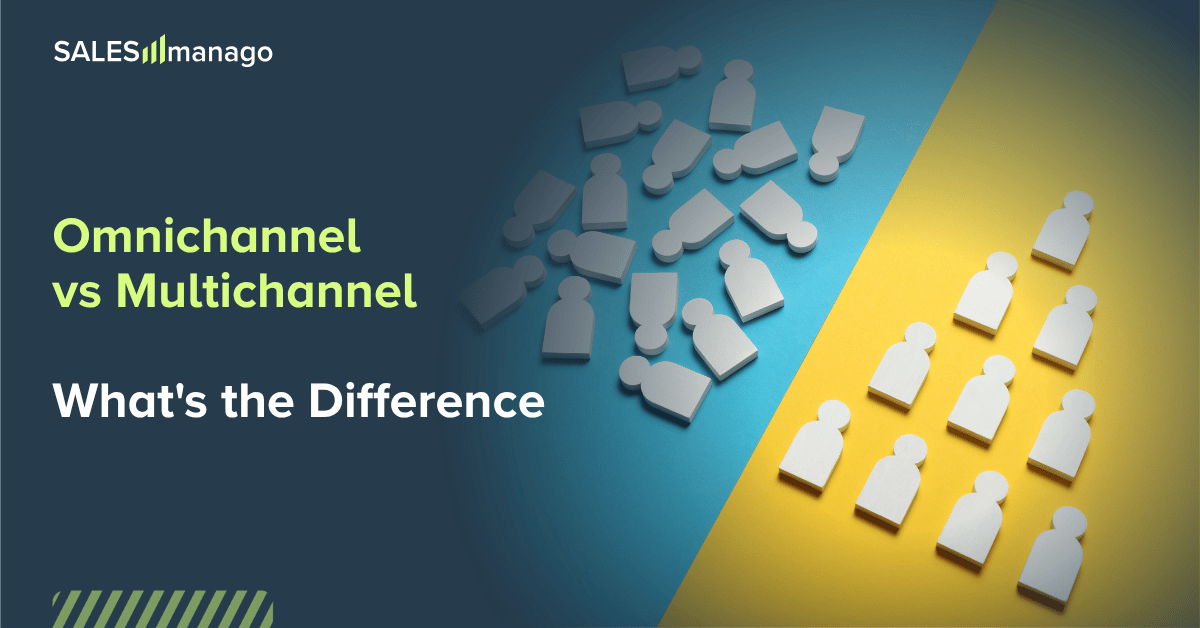
You’ve seen the slide before. You know the one with your brand in the middle, channels radiating outward like a proud little sun. Email, SMS, web push, social, paid ads, on-site personalisation, maybe a loyalty program if you're feeling ambitious. It says "
This month isn’t about being fooled by the next massive industry panic or buying into stressful, hyper-complex tech trends. Low-friction joy? Welcome to the era of Treatonomics.