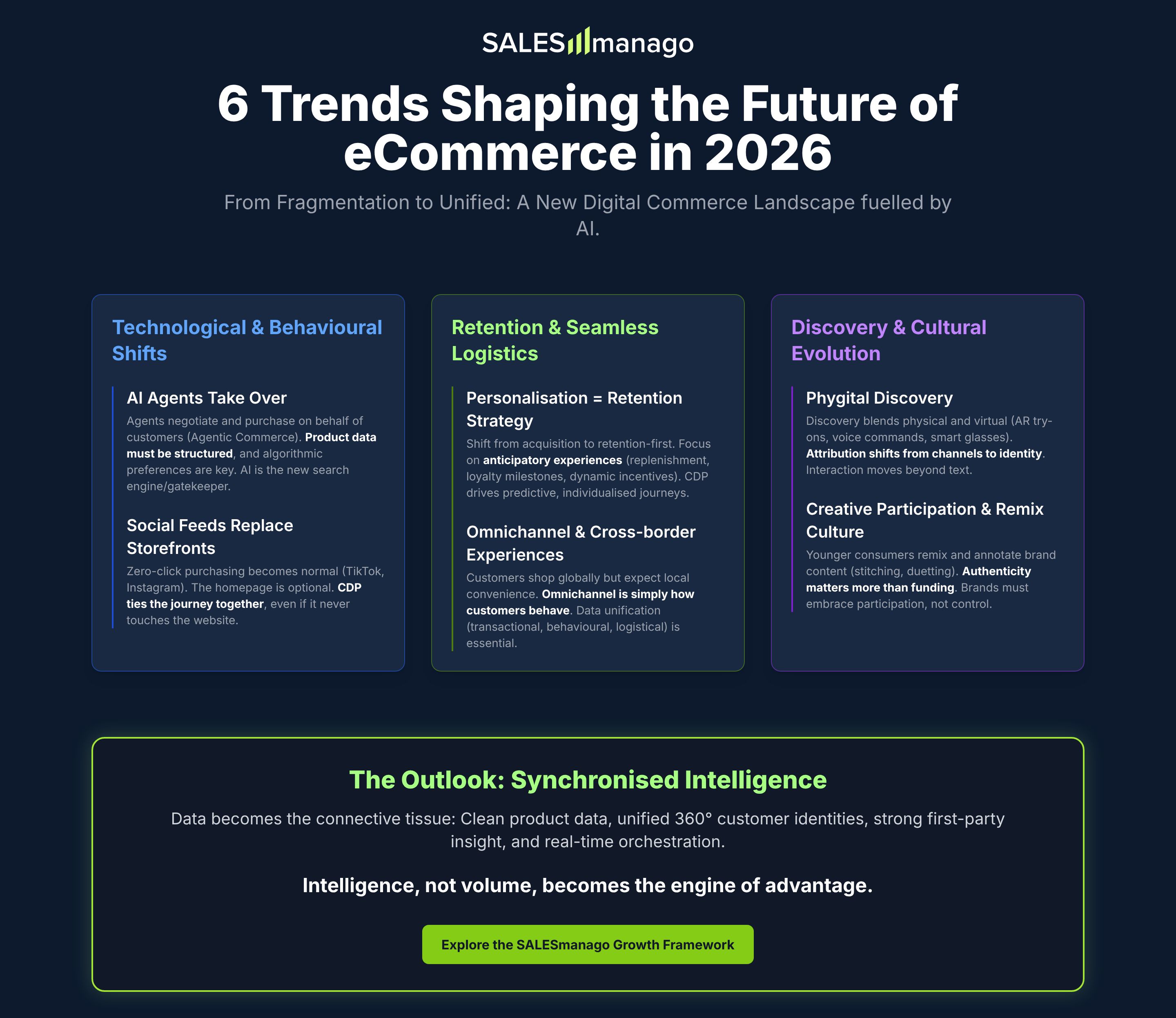
6 Trends Shaping the Future of eCommerce in 2026

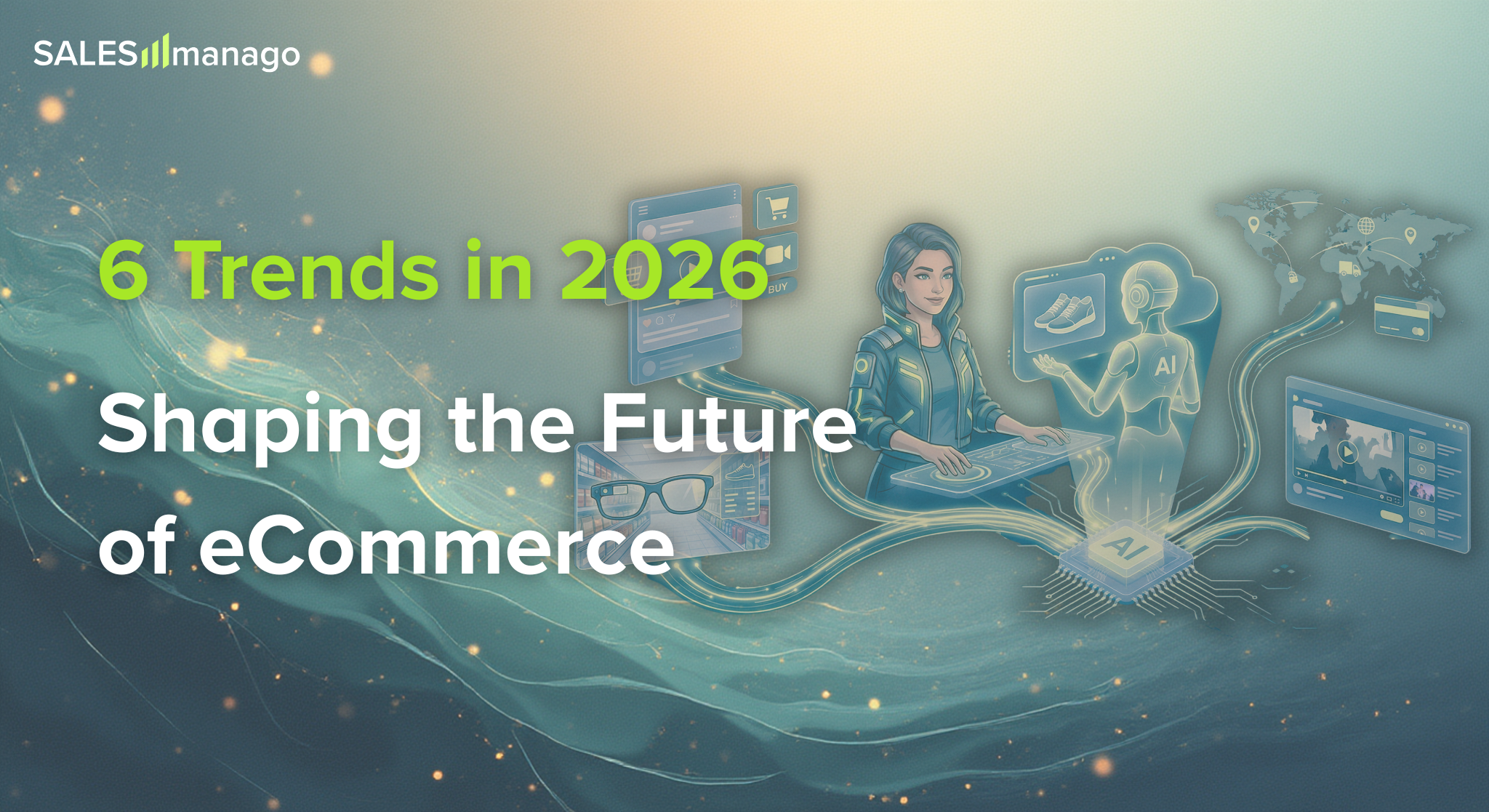
Every few years, eCommerce shifts in a way that forces leaders to rethink almost everything they have known so far. And 2026 feels like one of those years. We are now facing an unprecedented change caused by spreading AI solutions across all industries and markets. Every year, AI becomes more and more capable in areas that weren't even imagined 3 to 4 years ago (or at least not by anyone outside the scientific community.)
And now we live in a world where AI agents are beginning to shop on our behalf, social platforms are becoming fully closed commerce environments, and the customer journey is splintering across surfaces we didn’t consider a decade ago. At the same time, the economics of digital growth are changing. Retention and customer lifetime value matter more than ever, global demand keeps rising, and yet shopping behaviour is becoming more local and more fragmented.
The industry has been discussing these developments for years, but only now are they mature enough to influence strategy at scale. And fueled by the rise of AI, they spread at a pace that is difficult to catch up with and produce results hard to predict.
Let’s try to highlight at least a few of them.

Not long ago, the idea that AI agents would negotiate, compare and purchase products for people sounded like half-baked science fiction. But now we have a reality check: They do. And we have to prepare for a completely new category—agentic commerce which is an inevitable future.
What can we expect? AI agents shopping for us means that eCommerce brands will have to fight not only for customer attention but also for algorithmic preferences and agents will become just a normal part of the retail experience.
The important shift here is not about the technology but the changing balance of control. If an AI agent becomes the primary decision-maker, the brand’s job is no longer to persuade an individual but to be machine-interpretable and contextually relevant. That also means that product data must be properly structured, customer data must be unified and metadata will matter more than messaging. And the quality of a brand’s first-party intelligence will become its competitive edge.
In many ways, the AI agent will become the new search engine and the novel gatekeeper. At the same time, the human role could be reduced merely to reviewers of AI propositions. However, are we truly convinced that AI can choose better than we can?
If AI agents change how decisions are made, social commerce changes where they happen. We have to stop assuming that a website is a centre of the digital ecosystem and our only or primary conversion engine. Not anymore. Zero-click purchasing is becoming normal, especially on TikTok and Instagram, and soon on AI chats like GPT.
So, in 2026 the homepage will become optional. eCommerce moves to wherever the customer’s attention already is, which increasingly means within the feed, in livestreams, or through creators. For marketers, this eliminates the distinction between channels: Discovery, validation and purchase now happen in the same scroll. At the same time, going social means losing control and sharing it with third-party companies. There is a lesson from the media sector to be learned here.
Surprisingly, the role of the CDP is even greater than before. CDP becomes the system that ties this together, helping brands understand not just who bought but where the buying journey began, even if that journey never touched the website.
As acquisition costs rise, personalisation becomes central to profitable growth. McKinsey’s State of Fashion highlights the shift from acquisition-heavy models to retention-first strategies across leading brands.
What stands out here is not personalisation in the traditional sense but the transition towards anticipatory experiences: Replenishment reminders sent before the customer runs out, loyalty milestones triggered at exactly the right moment, dynamic incentives based on predicted discount sensitivity.
Moreover, retention is no longer a downstream activity but it is built into the entire lifecycle. This is where a CDP moves from infrastructure to strategy—giving brands the predictive signals needed to treat every customer as an individual, not a cohort.
As much as AI and social platforms are reshaping digital behaviour, the basics of commerce—delivery, availability, convenience—still determine outcomes. What has changed is the scale and complexity. Customers shop globally but expect local convenience: local payment methods, local delivery speeds, transparent return policies, and hassle-free order fulfilment from abroad.
Shopify’s global eCommerce statistics reflect this pattern clearly: Cross-border demand is rising but customers buy when, and only when, the experience feels local and reliable.
The point is clear here: Omnichannel is no longer something retailers “implement”. It is simply how customers behave. They may find a product in a local shop, order a variant online, collect it in-store, return it by post, and expect every step to be aware of the previous one.
And this is where data unification becomes essential. The only way to deliver a coherent omnichannel experience is to unify transactional, behavioural and logistical signals inside one system. The customer doesn’t see channels. Neither should brands.
The mix of physical and virtual worlds has been predicted years ago, but it seems that we are finally close to the moment when it will become mainstream. Brands are investing in AI-powered in-store experiences, AR-driven product exploration and multi-surface discovery that spans mobile, voice, wearables and smart displays.
In practice, this means fewer journeys that start with a browser search. A customer might begin with a voice command, a photo scan, an AR try-on or a product seen through smart glasses. They may then complete the purchase later on a different surface entirely. For marketers, attribution becomes less about channels and more about identity.
We are still not there yet. However with new generations raised on voice messages or communicating with AI agents vocally, we can easily notice that the methods of interaction with technology quickly shift from text to other variations and eCommerce brands along with their marketing teams need to be aware of it.
One of the more interesting cultural trends heading into 2026 is the way younger consumers relate to brands. They don’t simply consume content but they change it. Remixing, stitching, duetting, recreating and annotating have become natural behaviours, shaping not only culture but commerce.
This trend isn’t just about marketing aesthetics. It changes how products spread. A single customer video, creatively reinterpreted, can travel further and feel more authentic than a well-funded campaign. It also converts the relationship between customers and brands. When people participate in creating the story, rather than just consuming it, they develop a different kind of attachment.
The opportunity for brands is to embrace this behaviour, not control it.
When you put these six trends together you can see an interesting future landscape of eCommerce. AI agents reshape decision-making, social platforms absorb conversion, personalisation becomes a retention lever, logistics and cross-border experience set the baseline for trust, discovery shifts across surfaces, many of which are not screens. And culture becomes an operating variable, not an afterthought.
In this environment, the role of data becomes central. Not as dashboards or reports but as the connective tissue behind every experience. Clean product data, unified 360° customer identities, strong first-party insight and real-time orchestration. These become the foundations of growth.
If the previous decade was about adding channels, the next one is about synchronising them. Intelligence, not volume, becomes the engine of advantage.



Google "what percentage of loyalty programs fail" and you'll get a wider range than the Andes (world’s longest mountain range for those of you who failed Geography). Depending where you read anywhere from 20% to 97%. That tells you two things. First, nobody really agrees on what "fail" even means. Second, quite a lot of loyalty programs aren&...
You’ve seen the slide before. You know the one with your brand in the middle, channels radiating outward like a proud little sun. Email, SMS, web push, social, paid ads, on-site personalisation, maybe a loyalty program if you're feeling ambitious. It says "
This month isn’t about being fooled by the next massive industry panic or buying into stressful, hyper-complex tech trends. Low-friction joy? Welcome to the era of Treatonomics.