Customer Data Platform Examples: Real Use Cases from eCommerce Brands (Not Just Vendor Lists)

You came here looking for CDP examples, right?
Let me guess what happened. You googled “customer data platform examples“ and clicked on three articles that all said the same thing: “Here are 15 amazing CDPs!” followed by a parade of logos and generic descriptions that could’ve been written by the vendors themselves.
Problem is, you weren’t actually looking for a software directory. You were looking for proof. Does this thing work? What does success look like? Will it work for my business, or just for massive enterprises with unlimited budgets?
That’s what we’re covering here. Not another list of “top CDP companies” or a rundown of customer data platform companies. Instead, you’re getting the messy, honest truth about what CDP implementations actually look like when they work, and what you should look out for.
A lot of people search “customer data platform examples” and actually mean “examples of CDP tools I could buy.” So before we dive into real-world implementations, here’s a quick, non-exhaustive list of commonly cited CDP platforms:
Salesforce Data Cloud (Salesforce CDP)
Adobe Real-Time CDP (Adobe Experience Platform)
Oracle Unity Customer Data Platform
SAP Customer Data Platform
Tealium AudienceStream
Treasure Data CDP
mParticle
Segment (Twilio Segment)
ActionIQ
This list is provided for convenience and is not a ranking based on key features or a comparison of the essential functionalities of these platforms.
This isn’t a recommendation, and it’s definitely not “the best CDPs list”. It’s here so you don’t have to bounce back to Google if your boss asked you for “platform examples.”
Now, if what you are really looking to find is: “What do CDP wins look like in real businesses?”, then you’re in luck… keep reading.
.png)
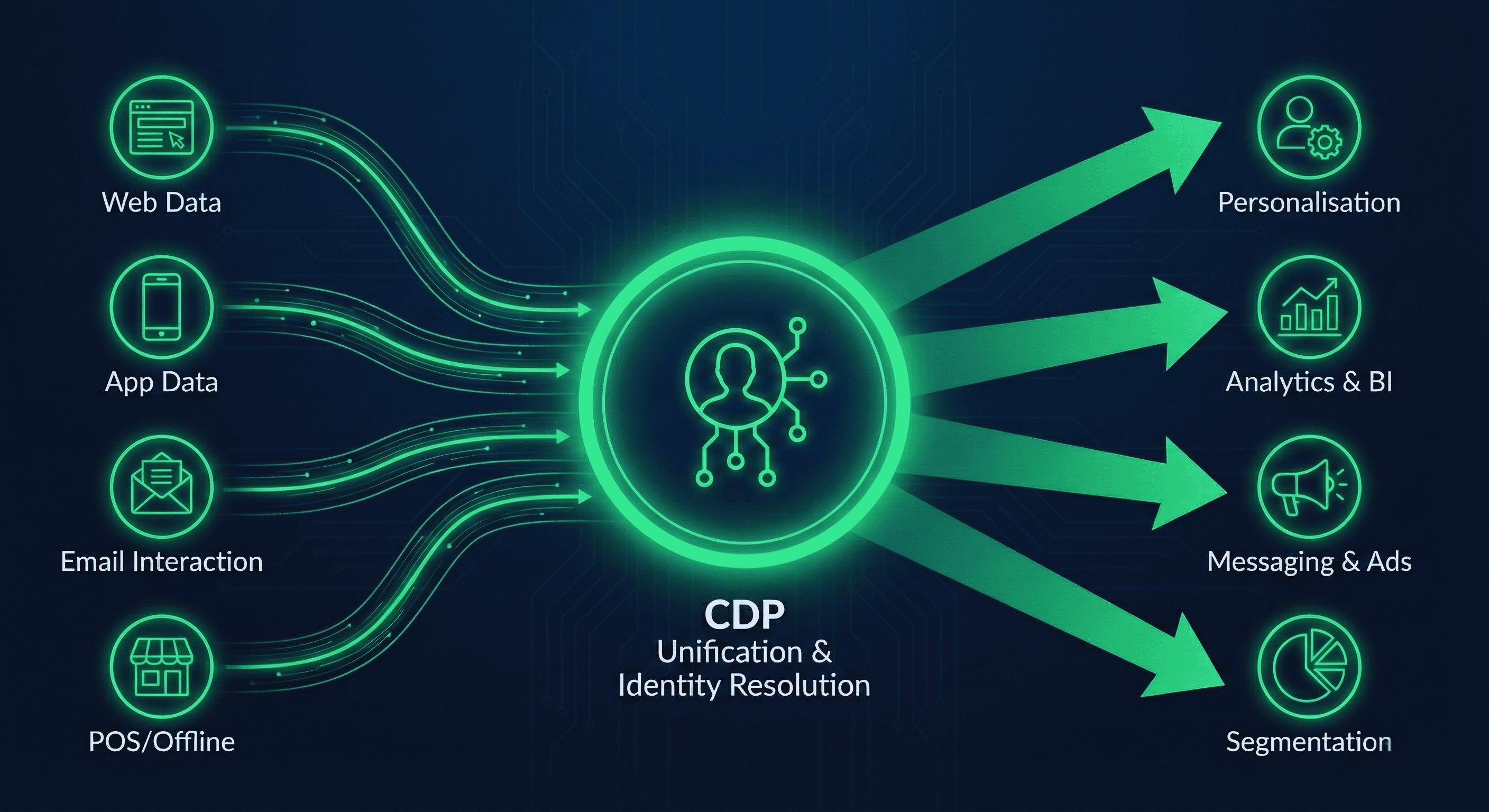
A CDP is a system that pulls customer data from multiple sources (website, app, email, POS, support, etc.), collecting data from multiple data sources, including first party data, to centralise and unify customer information. It resolves this data into a unified customer profile by integrating data from various systems to create a unified customer database, which serves as a single source of truth accessible across your organization. This data is then made usable for activation (personalisation, segmentation, analytics, and messaging) across your marketing stack.
In other words: It’s a database plus identity resolution plus activation.
Before we get into specific cases, we need to talk about what you should even be looking for in a CDP example. Because most people are asking the wrong questions.
When you’re evaluating CDP examples, you’re not trying to figure out if a platform can “unify customer data” or “enable personalisation.” Of course it can, that’s literally the definition of a CDP. The question is whether it can do that for a business like yours, with your budget, your team size, and your specific chaos.
The best customer data platform examples show how accurate customer profiles lead to valuable insights that drive actual decisions. Look for cases where data integration delivered actionable information, with measurable improvements in marketing performance or customer engagement. The difference between a good example and vendor fluff is whether someone acted on those insights, and revenue moved.
1. Does this example match my business reality?
If you’re a mid-market eCommerce brand doing €5M in annual revenue, an example of how Coca-Cola uses Salesforce CDP is about as useful as a chocolate teapot. Different planet, different problems.
2. Can I see the implementation mess?
Every CDP success story glosses over the same thing: the three months of hell getting the thing set up, the IT resources it ate, the projects that got delayed. If an example doesn’t mention time-to-value or implementation complexity, it’s hiding something.
3. Are the metrics believable?
“Improved customer engagement by 40%” means nothing. What actually changed? Did revenue go up? By how much? What was the baseline? If you can’t see the math, you can’t trust the example. Make sure the metrics are based on relevant data that truly reflects the impact of the CDP implementation, not just vanity numbers.
4. Would this work in Europe?
Most CDP examples are written for the US market, where businesses operate on different scales, data privacy rules are looser, and everyone’s integrated with the same American tech stack. GDPR isn’t something they really even have to consider, but it changes everything.
Let’s get into it. Here are the use cases where CDPs make the most difference, with examples of what success looks like. CDPs can be used to optimize the customer journey across various touchpoints by tracking and understanding all customer interactions, enabling more personalized and effective marketing strategies.
Every CDP vendor claims they’ll “recover lost revenue from cart abandonment.” Then you implement it and… your abandoned cart emails perform roughly the same as they did before, just with a more complicated setup.
Why? Because most CDPs treat cart abandonment like it’s a simple trigger: cart abandoned → send email. But cart abandonment isn’t one behavior, it’s dozens. Someone abandoning a €500 purchase after 20 minutes of browsing is not the same as someone leaving a €30 item in their cart while they grab lunch.
Where it actually works:
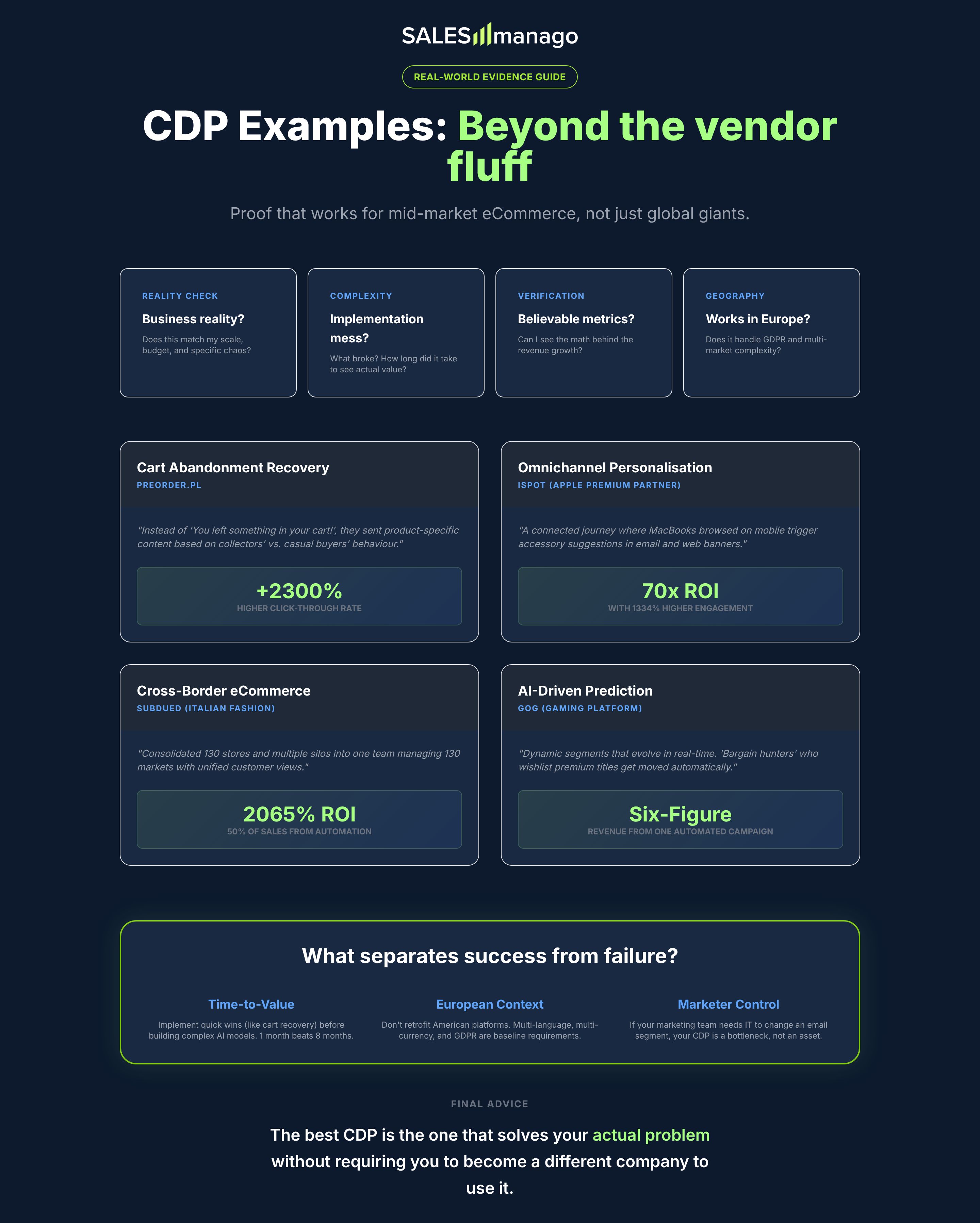
Preorder.pl, a Polish music retailer, cracked this using dynamic abandoned cart emails that changed based on browse time, cart value, and product type. Their abandoned cart emails hit a 2300% higher click-through rate compared to standard newsletters.
Preorder.pl leveraged customer data points such as purchase history and user behavior—including website visits, engagement with content, and previous transactions—to personalize abandoned cart emails. This allowed them to trigger highly relevant messages and recommendations tailored to each customer.
That number sounds fake until you understand what they changed. Instead of “You left something in your cart!” (which everyone ignores), they sent product-specific content based on what was actually in the cart. Vinyl collector eyeing limited edition? Show pressing numbers and stock status. Casual buyer with a mainstream album? Highlight similar purchases from other customers.
This wasn’t possible with their previous setup (MailChimp plus Google Analytics plus Shopify). It needed a CDP that could handle behavioral triggers, product catalog sync, and dynamic content generation in one place.
Check out more about how CDP helped Preorder.pl
Compare this to enterprise:
Could Salesforce CDP do this? Technically yes. But you’d need a developer to build custom integrations, a data scientist to set up the segmentation logic, and a six-month implementation timeline. By the time it’s live, you’ve spent more on setup than you’d have recovered in cart value.
“Omnichannel personalisation” has become marketing’s favorite lie. Most companies mean “we can send emails AND SMS now.” That’s not omnichannel, Karen, that’s just… two channels.
Real omnichannel personalisation means a customer’s experience on your website changes based on what they did in your app, which was informed by an email they received, which responded to a purchase they made in-store. The whole journey is connected, not just bolted together.
And most CDPs can’t actually do this without massive custom work.
The gap nobody talks about:
Here’s what happens in reality. You implement a CDP. You connect your email platform, your website, your mobile app. Everything’s unified! Except… your web personalisation engine needs specific data formats. Your email tool requires different segment structures. Your mobile SDK speaks a different language. Your CDP becomes a very expensive data lake that requires constant engineering work to actually use.
iSpot, Poland’s largest Apple Premium Partner, figured this out the hard way. They tried three different setups before landing on a platform that actually let marketing teams (not just developers) create omnichannel experiences.
Their final setup delivered personalised product recommendations across website, app, and email, all pulling from the same unified customer profile. The CDP personalised experiences across multiple channels, allowing iSpot to activate customer data on email, web, and app touchpoints. Someone browsing MacBooks on mobile would see related accessories in email, with web banners adjusting based on their app behavior.
Read more about iSpot’s final setup.
The result? 70x ROI and email engagement rates 1334% higher than industry standards. But here’s what matters even more… their marketing team controls it. No developer tickets, no three-week turnaround times.
If you’re selling across multiple European markets, you’ve discovered something frustrating: most CDPs were built for American companies selling to Americans. They don’t get multi-language, multi-currency, multi-VAT-rate, multi-we-can-do-this-in-Germany-but-not-in-France complexity.
Try running a promotion across Germany, France, and Poland simultaneously. Different languages, different payment preferences, different shipping costs, different product availability, different legal requirements for how you can contact customers without resulting in multi-lawsuits-bigger-than-the-Eifel-Tower.
Your CDP needs to handle all of that without creating separate customer profiles for the same person buying in different markets.
What breaks:
Subdued, an Italian fashion brand operating across 130 stores and multiple European markets, ran into this exact wall. Their previous setup treated each market as a separate silo, creating data silos that prevented a unified customer view across markets. A customer shopping in Italy and Germany appeared as two different people. Abandoned cart emails went out in the wrong language. Promotions didn’t account for local VAT rates. The whole thing was held together with duct tape and prayer.
After implementing a proper multi-market CDP setup, they achieved 2065% ROI with 50% of sales driven by automation. But again, the real win was operational, one marketing team managing all markets, not separate teams using fragmented data.
Come find out how Subdued achieved 2065% ROI
The enterprise tax:
Adobe Experience Cloud can handle this. So can Salesforce Commerce Cloud with enough customisation. But you’re looking at hundreds of thousands in licensing, plus consultants to make it work. For mid-market eCommerce? That’s not even in the right ballpark for most needs.
Every CDP now claims “AI-powered segmentation.” What they mean is “we have some basic machine learning that groups customers by behavior.” Which is fine, but it’s not exactly revolutionary.
Real AI-driven segmentation doesn’t group customers, but instead predicts what they’ll do next and automatically adjusts segments in real-time. Someone moving from “casual browser” to “high-intent buyer” gets treated differently immediately, not after your weekly batch process runs.
The problem with most AI segmentation:
It’s passive. The system tells you “these customers are likely to churn” and then… you manually create a campaign. You’re still doing the heavy lifting.
What you actually want is segmentation that triggers action. Someone hits “high churn risk”? The system automatically adjusts their journey, maybe by holding back aggressive promotion emails, switching to value-reinforcement content, offering a limited-time retention incentive.
GOG (the gaming platform) built this kind of system for their onboarding campaign. New users got sorted into dynamic segments based on initial behavior, like browsing patterns, wishlist additions, first purchase category. The segments weren’t static; they evolved as behavior changed. Someone who looked like a “bargain hunter” on day one but started wishlisting premium titles by day three got moved automatically. This type of AI audience segmentation allows for real-time adjustments to these segments based on customer behavior, allowing for highly targeted and personalised experiences.
The end result was a six-figure revenue from a single automated campaign. But more impressive was that they built this in weeks, not months. Their marketing team did it, not their engineering team.
How did they do it?Find out here
Short answer: Yes, but not how you’re thinking right now.
While some companies may consider a data management platform (DMP) as an alternative, DMPs are used for advertising and focus on behavioral data collection. In contrast, customer data platforms (CDPs) offer more customer data integration, making them better suited for organizations seeking a unified view of their customers.
Let’s get the obvious ones out of the way.
Salesforce CDP powers major brands like Adidas. It works. It’s powerful. It also requires a dedicated team to manage it, integration specialists to connect everything, and a budget that starts at six figures annually. Salesforce CDP integrates with ad platforms such as Google Ads, enabling large-scale marketing campaigns by activating customer data for targeted advertising and remarketing.
If you’re a Fortune 500 company with an IT department and unlimited resources, great. If you’re not, this is like buying a Formula 1 car to commute to work, technically, bloody excellent, practically, a waste of money.
Adobe Experience Platform is similar. Incredible for massive enterprises with complex needs. It also connects with ad platforms like Google Ads to allow personalised, cross-channel marketing campaigns using unified customer data. Insanely overcomplicated for most needs.
Oracle Unity exists in its own enterprise bubble. Beautiful technology, beautiful price tag, beautiful documentation that assumes you have a team of database administrators on staff.
These aren’t bad systems. They’re just solving different problems than what mid-market eCommerce faces. And every article that lists these as “great CDP examples” without mentioning the implementation reality is doing you a disservice.
This is where it gets interesting, because mid-market eCommerce has different constraints than enterprise. You can’t throw unlimited budget at problems. You don’t have spare developers waiting for work. Your marketing team needs to actually use the thing, not file tickets with IT.
Seconda Strada, an Italian fashion retailer, transformed their marketing operations in a single quarter using a mid-market-focused CDP. The platform now drives 75% of their total transactions and increased sales attribution by 15%.
What made it work? Not more features, but less friction. Their marketing team set up campaigns without developer help. Time from idea to execution dropped from weeks to hours. They could test, iterate, and optimise fast enough to actually learn something.
4 Madonne Caseificio, a traditional Italian cheese producer, achieved 167% increase in last-click sales year-over-year. An 80-year-old company making Parmigiano Reggiano shouldn’t be crushing it with marketing automation, but here we are. What made the difference? A CDP that respected their reality, which was limited technical resources, traditional business model, need for simple workflows that actually work. By leveraging customer data, they were able to increase customer loyalty and drive repeat purchases among existing customers through targeted retention campaigns.
See how they got more cheddar from their Parmigiano
These aren’t sexy Silicon Valley startups. They’re normal businesses like yours with normal constraints, but doing abnormal results because they picked technology that fit their reality.
If you’re a startup, you probably don’t need a full CDP yet. You need customer data that doesn’t suck, basic segmentation, and the ability to send targeted emails without losing your mind.
Platforms like Segment (now owned by Twilio) work well here. They’re essentially data routing layers that make sure customer information flows between your tools. Is it a “real CDP”? Debatable. Does it solve the startup problem of “our data is everywhere and nothing talks to anything”? Yes.
Klaviyo is another option that works for eCommerce startups. It’s marketed as an email platform with CDP features, which is accurate. You get unified customer profiles and decent segmentation, but you’re limited to Klaviyo’s ecosystem. A key benefit for startups is Klaviyo’s intuitive user interface, making it easy to set up automations and manage campaigns even with limited technical resources.
The trade-off is clear: lighter implementation, lower cost, less customisation. For startups, that’s usually the right call.
Successful customer data platform examples consistently use customer insights, marketing analytics, and campaign metrics derived from high-quality data points. These capabilities allow you to better understand your customers, personalise experiences, and optimise marketing strategies.
The entire point is to activate your data effectively and maintain data integrity throughout the process, making sure it's accurate, consistent, and reliable information.
After looking at dozens of CDP implementations, patterns start to emerge. Not about which platform is “best” (because that’s the wrong question), but about what separates working implementations from expensive failures.
Nobody cares that your CDP has 847 features if it takes eight months to see results. The implementations that actually work are the ones that deliver quick wins while building toward complexity.
Preorder.pl didn’t start with 37 automated workflows and predictive AI segments. They started with abandoned cart recovery. Worked. Then added browse abandonment. Worked. Then built out category-specific recommendations. Each step paid for itself before the next started.
Compare that to companies who try to implement everything at once, spend nine months in “setup mode,” then launch a massive system that nobody understands. Those projects fail spectacularly, usually in ways nobody wants to talk about.
A step-by-step approach not only delivers quick wins but also lays the groundwork for long-term customer loyalty.
This keeps coming up, so let's just say it directly: most CDP "success stories" are American companies with American challenges. Multi-state complexity is not the same as multi-country complexity.
When you're operating across European markets, you're dealing with different languages, currencies, payment methods, legal frameworks, customer expectations, and competition, all within a region smaller than the United States. That requires a different approach to data management.
The CDP examples that work in Europe are the ones built with these constraints in mind, not American platforms trying to retrofit European compliance afterward.
Here's an uncomfortable truth: the most technically sophisticated CDP is useless if your marketing team can't operate it independently.
Plenty of companies have implemented powerful CDP platforms that require a developer for every campaign change. Marketing becomes a bottleneck, experimentation dies, and the expensive platform delivers a fraction of its potential value.
The examples that work are ones where marketers control the CDP directly. Changing segments, adjusting workflows, testing new approaches without filing IT tickets.
After looking at all these cases, here’s the framework for making sense of CDP examples you’ll encounter, whether in this article or anywhere else.
The Anti-failure Detection Questions:
When you see any CDP success story, run it through these filters:
Is this company remotely like mine? A global enterprise with 50,000 employees is not useful as an example for a 200-person eCommerce brand. Neither is a Silicon Valley startup with unlimited VC funding. Look for examples from your actual peer group.
Can I see the mess? Real implementations hit problems. If the case study only shows smooth sailing from day one, it’s hiding something. The useful examples explain what broke and how they fixed it.
Who’s running it day-to-day? If every example mentions data engineering teams and IT partnerships, that platform isn’t built for marketing teams to operate. You want examples where marketers are doing the work.
What’s the geography? US-based success stories operate under different constraints than European businesses. GDPR is a specific tripwire that changes what you can do with data.
Where did they start? Companies that tried to implement everything at once usually regret it. The smart examples show a crawl-walk-run approach: solve one problem well, then expand.
If you've made it this far, you're probably overthinking this. Here's what actually moves you forward:
First: Name your constraint. Not "we need a CDP" but "we can't personalise emails because our data lives in six places." The specific problem determines which examples matter.
Second: Look at three examples max from your segment. B2C eCommerce in Europe? Find three companies like yours that succeeded. That's enough data. More examples just create decision paralysis.
Third: Check the implementation timeline. If it takes more than three months to see first value, the platform is too complicated for your team size. Walk away.
Fourth: Ask about month 13. Every vendor shows you year one. What happens after that? Does it get easier as you learn the system, or do you accumulate technical debt that requires more and more resources?
Fifth: Stop collecting information. At some point, more research is just procrastination. You know enough. Make a decision.
The best CDP is the one that solves your actual problem without requiring you to become a different company to use it.
What is a “customer data platform example”?
It can mean two different things:
A CDP platform example (a specific vendor/tool).
A CDP implementation example (a real use case showing how a business used a CDP to get a result).
What’s the difference between CDP and CRM and DMP?
A CRM (customer relationship management system) is basically a fancy contact database. It tracks who your customers are, what they bought, when sales called them, and what support tickets they opened. It's a system of record, great for managing relationships, terrible for activating data across marketing channels.
A DMP (data management platform) is the thing that's quietly dying now that third-party cookies are toast. DMPs focused on anonymous audiences and third-party data, like buying lists of "people who might be interested in shoes" from data brokers, then using that for advertising. Useful for awareness campaigns, useless for actual customer relationships.
A CDP is different. It's built around first-party customer data, which is the information you collected directly from customer interactions. Someone browsed your website, bought something, opened an email, used your app. That's your data, about actual people who chose to interact with you.
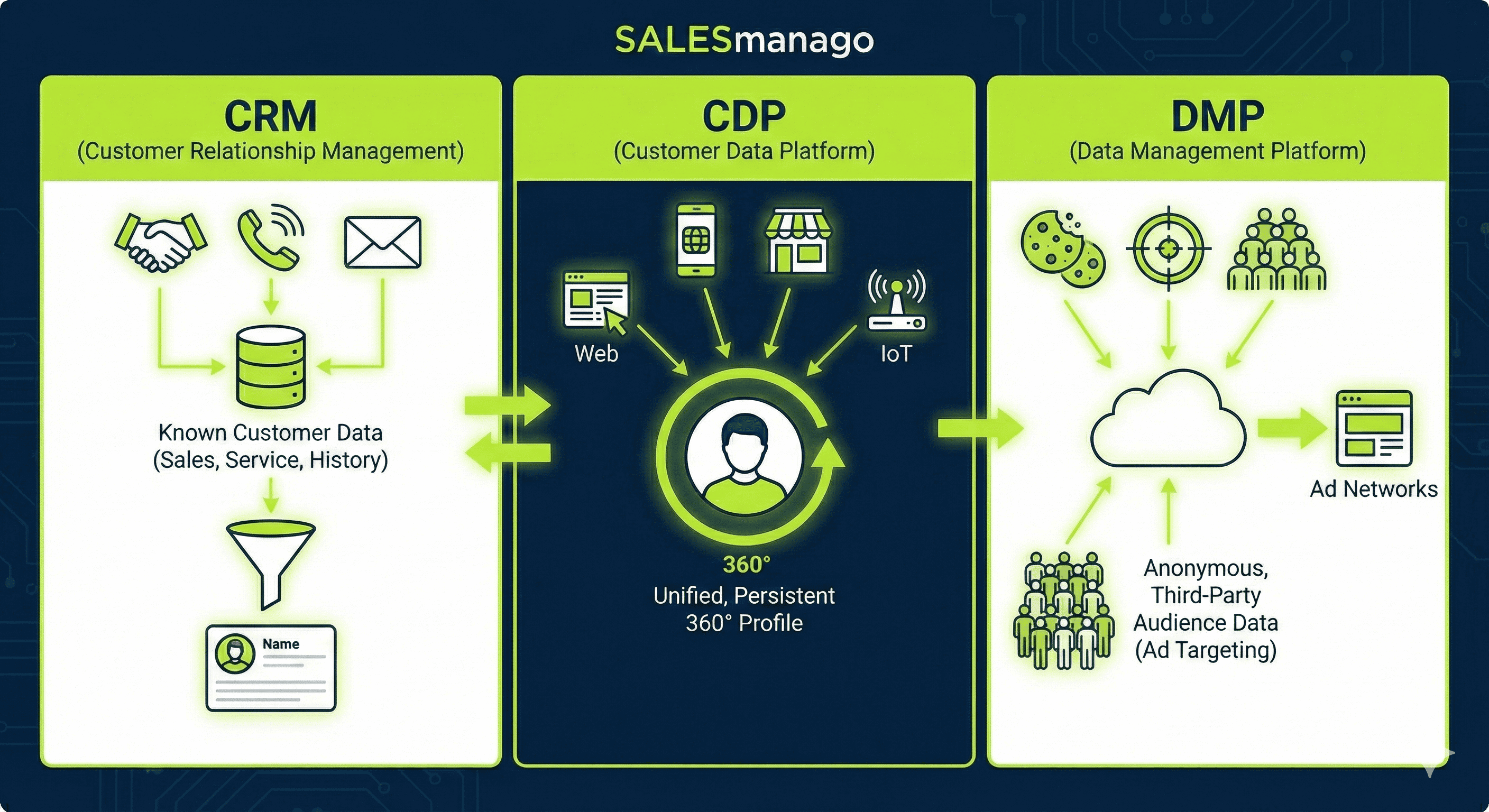
The key difference? A CDP unifies all that first-party data into profiles, then lets you activate it across channels. Same customer, consistent experience whether they're getting an email, seeing an onsite recommendation, or being retargeted with ads.
CRMs tell you who someone is. DMPs tell you who might want your product. CDPs let you actually do something useful with data about people who already care.
Do I need a CDP if I already have an ESP and GA4?
Maybe, maybe not. If your segmentation and personalisation is limited because data is fragmented across tools, or you can’t reliably identify the same customer across touchpoints, that’s where a CDP can help. If you’re small and your existing stack already gives you fast execution, a CDP can be overkill.
How long does CDP implementation take?
It depends less on the vendor and more on your data reality: tracking quality, identity resolution needs, number of sources, governance, and who owns it internally. Some teams get a meaningful win in weeks. Others spend months integrating and still can’t activate reliably.
What are the most common CDP use cases?
The highest-frequency ones are:
Cart abandonment and lifecycle messaging
Audience building and suppression (who not to message)
Personalised onsite/app experiences
Cross-channel orchestration (email/SMS/paid/onsite)
Identity resolution (one customer across multiple systems)
Tracking and optimizing customer interactions across channels
What should I look for in “credible” CDP results?
Baseline + timeframe + KPI definition + what changed. If you can’t tell what the team actually did differently, you’re looking at marketing, not an example.
The best CDP examples aren't the ones with the biggest logos or the most impressive percentage increases.
They're the ones where you can see yourself. Companies with the same constraints, same team size, same problems. Where the success is specific enough that you know it's real, not just marketing fluff.
You've got what you need now. The rest is just deciding whether you're ready to move or not.



Google "what percentage of loyalty programs fail" and you'll get a wider range than the Andes (world’s longest mountain range for those of you who failed Geography). Depending where you read anywhere from 20% to 97%. That tells you two things. First, nobody really agrees on what "fail" even means. Second, quite a lot of loyalty programs aren&...
You’ve seen the slide before. You know the one with your brand in the middle, channels radiating outward like a proud little sun. Email, SMS, web push, social, paid ads, on-site personalisation, maybe a loyalty program if you're feeling ambitious. It says "

This month isn’t about being fooled by the next massive industry panic or buying into stressful, hyper-complex tech trends. Low-friction joy? Welcome to the era of Treatonomics.