Customer Engagement Platform vs CRM: What's The Difference For eCommerce (and Which Do You Need)?

People often compare customer engagement platforms vs CRM as if they're interchangeable. They're not. That misunderstanding is how brands end up with great tools that still produce chaotic customer experiences.
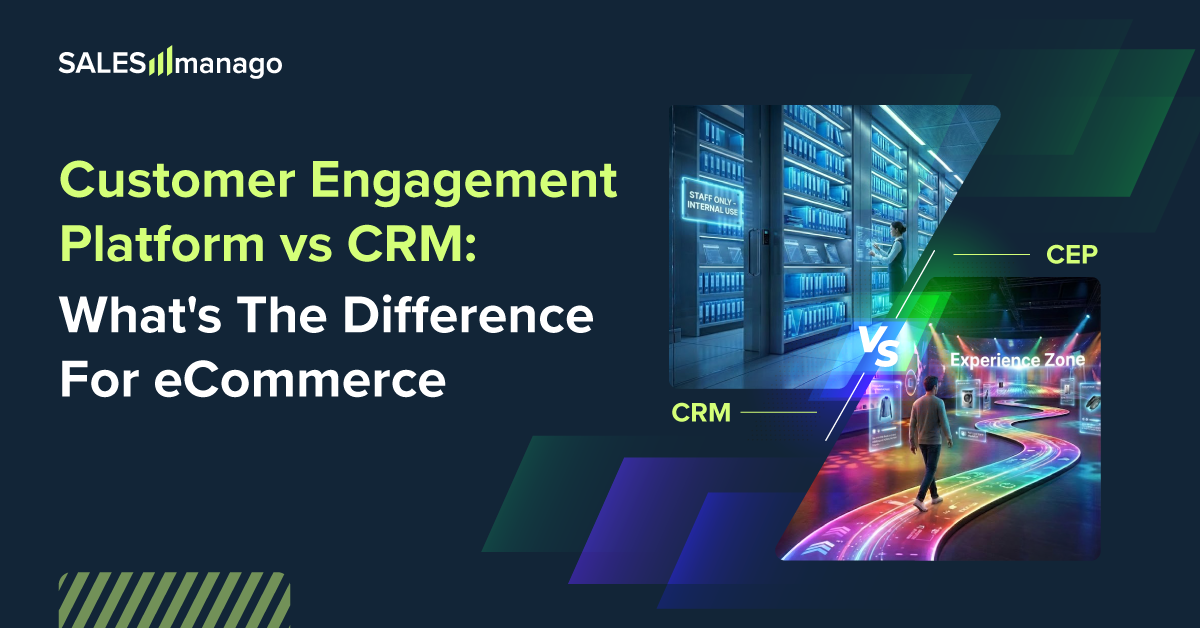
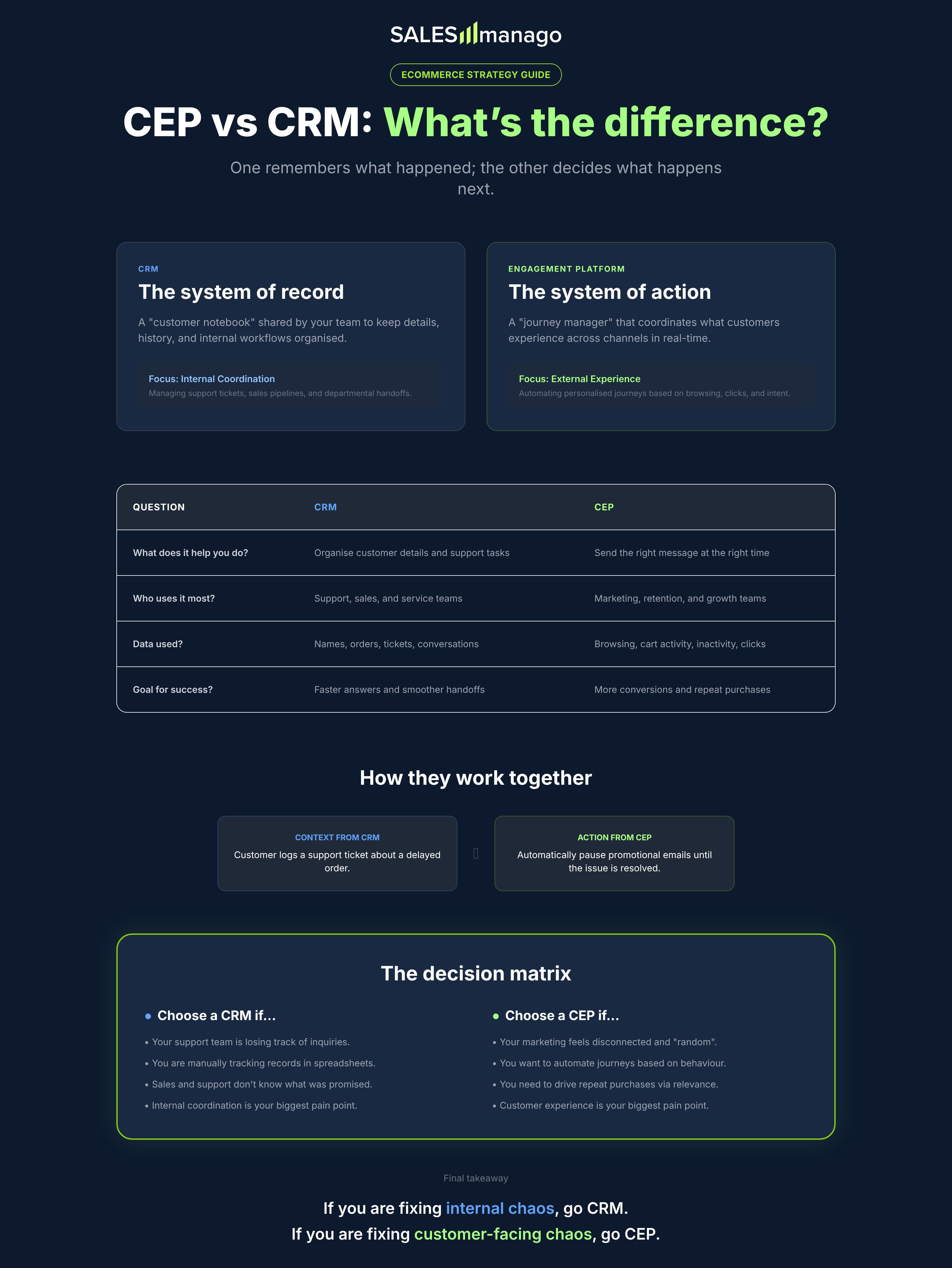
A CRM helps your team manage customer records and internal workflows. A customer engagement platform (CEP) helps you coordinate what customers experience, such as personalised journeys across channels, often triggered by user behaviour.
And yes, in real use cases, there's sometimes a little overlap, just enough to confuse everyone at least once. So here is a simple rule of thumb to make sure you remember how to separate them:
CRM = system of record. A customer relationship management (CRM) system is designed for managing customer data and interactions. It keeps the details straight: who the customer is, what they bought, what they asked, and what your team did about it. CRMs are primarily focused on managing customer data for sales and support teams.
Customer engagement platform = system of action. It helps you decide what happens next: which message, which channel, which timing, and which customers should get it.
Both tools aim to build lasting customer relationships, but they do so through different approaches. CRMs do it by organising and managing customer data, and CEPs by enabling personalised, real-time engagement across the customer journey.
Customer engagement is about building meaningful, ongoing relationships with your customers through every interaction and touchpoint. In your eCommerce set-up, you know simply making a sale isn't enough these days. Customers expect brands to understand their needs, respond quickly, and deliver value at every step. This is where a customer engagement platform (CEP) can help.
A CEP allows your business to manage and optimise customer interactions across multiple channels, such as email, SMS, web, social, etc, and ensures every engagement feels personal and relevant. By using an engagement platform, a brand can meet customer expectations, improve customer satisfaction, and nurture loyalty that eventually leads to more business. The right customer engagement strategy, run on the right platform, helps your customers feel valued and connected to your brand at every stage of their journey.
>> Hungry for knowledge? Learn about differences between customer data platform and CRM.
| Question | CRM | Customer Engagement Platform (CEP) |
|---|---|---|
| What is it, really? | A "customer notebook" your team shares. | A "journey manager" for what customers see and receive. |
| What does it help you do? | Keep customer details, history, and support/sales tasks organized, with a key focus on managing customer relationships. | Send the right message/experience at the right time, across channels. |
| Who uses it most? | Support teams, sales team, account managers, customer service teams, service teams. | Marketing, retention/lifecycle teams, growth teams. |
| What kind of info does it use? | Names, orders, tickets, conversations, notes. | Browsing, cart activity, purchases, clicks, inactivity, preferences. |
| When does it matter most? | When your team needs context to help a customer. | When you want to react to customer behavior quickly. |
| What does "success" look like? | Faster answers, fewer internal mistakes, smoother handoffs. | More conversions, more repeat purchases, fewer "random" messages. |
| Common eCommerce win | Support knows what's going on instantly | Customers get relevant nudges instead of spam. |
Both platforms are designed to support customer relationships, but CRMs typically focus on managing customer relationships and departmental solutions, while CEPs coordinate engagement activities across the entire customer journey.
A CRM is basically your company's shared memory about customers. It's where teams keep the facts straight: who someone is, what's happened before, and what your company needs to do next on your side.
In practical terms, a CRM helps you answer questions like:
Is this customer new or a regular? Have they contacted support before? Did we promise them anything? Is there an open issue, and who's supposed to handle it? How are we managing customer information and storing customer information for easy access?
CRMs are especially useful for sales and service because they turn customer interactions into a consistent process. CRM solutions help with managing customer sales and tracking customer sales data to enhance relationships and drive revenue growth. Instead of five people each having "their own version of the story," everyone works from the same record.
A customer messages support: "It says my order's delivered but I don't have it."
A CRM is where your team can quickly see your customer's order history, previous tickets, and whether this is a one-off or the third delivery problem in a row. That context makes the response faster, calmer, and more consistent.
What a CRM is great at (especially for eCommerce teams):
Keeping customer details, conversations, and support issues organized
Making handoffs smoother (support, operations, account management)
Giving your team a reliable "source of record" for customer history
Data management: serving as a centralized repository for customer data to support engagement strategies
Managing service data, including customer service interactions, workflows, and service tickets
Supporting service level agreements (SLAs) to ensure timely resolution of customer issues
What CRMs aren't built for
CRMs track what your team does. They're not designed to coordinate what customers see across multiple channels. If you want someone to get an email after abandoning their cart, then a follow-up SMS two days later, then a special discount if they still haven't converted, that's customer engagement platform territory.
Think of it this way: your CRM tells you what happened. Your customer engagement platform decides what should happen next.
A customer engagement platform is built to manage what customers experience as they move through your brand’s touchpoints.
Here's what that looks like in practice:
Someone browses winter coats but doesn't buy. They abandon their cart. Two days go by. Then they come back and browse again, but still don't convert.
A CEP tracks all of that customer behavior and responds accordingly. Maybe it sends an email reminder. Then an SMS with free shipping. Then shows different product recommendations onsite next time they visit. All part of one coordinated customer journey, not five random messages that are disconnected.
What makes a customer engagement platform different from other tools?
It works across channels. Email, SMS, push notifications, web personalization are coordinated, not siloed.
It reacts to behavior. Browsing, purchases, clicks, inactivity trigger the next step in the customer journey.
It personalizes at scale. Using customer data to deliver personalized customer experience to thousands (or millions) of people.
It automates engagement. Once you build the journey, the engagement platform handles execution without manual work.
The best customer engagement platforms also understand customer preferences and use data management to create a unified customer profile. That way, your messaging doesn't just feel relevant; it actually is.
Real example: cart abandonment done right
Let's say someone adds items to their cart but leaves. A basic system might send one generic email. A customer engagement platform builds a whole sequence:
Hour 1: Email reminder with product images
Day 2: SMS with a discount code
Day 4: Final email showing similar products they might like
If they buy: Stop the sequence immediately (no one wants post-purchase nagging)
If they don't: Add them to a "browse abandoners" segment for future campaigns
That's behavior-driven, cross-channel customer engagement that actually works. It's not random. It's coordinated.
A CRM makes sense when you have customer interactions happening across your team and need everyone on the same page. If your support, sales, and account teams are constantly asking "Wait, who talked to this customer last?" you need a CRM.
Signs you need a CRM:
Customer inquiries are getting lost between team members
You're manually tracking customer records in spreadsheets (painful)
Support doesn't know what sales promised, or vice versa
You can't quickly see a customer's history when they contact you
Your team needs better contact management and operational efficiency
CRM systems shine when internal coordination matters. Managing customer data, tracking customer service interactions, and keeping everyone aligned on customer relationships, that's what they're built for.
When you might not need one yet
If you're still small and customer interactions are simple, a CRM might be overkill. If one person handles support, sales, and customer success initiatives, they probably remember who's who without needing CRM solutions. Don't add complexity before you need it.
But once you hit a certain scale, or once handoffs between team members start getting messy, get a CRM. It'll save you way more time than it takes to set up.
A customer engagement platform makes sense when customer behavior matters more than customer history. If you want to respond to what people do (or don't do) in real-time, you need a CEP.
Signs you need a customer engagement platform:
You're sending messages across multiple channels but they feel disconnected
You want to automate customer journeys based on behavior, not just blast campaigns
Customers complain about getting too many (or irrelevant) messages
You need to improve customer support by being proactive, not just reactive
You want to drive repeat purchases through timely, relevant engagement
Customer engagement platforms work best when you've got enough customer data to personalize at scale. If you understand customer behavior and want to act on it (not just record it), a CEP is where you'll see ROI.
When it's worth the investment
Honestly? If you're doing any kind of lifecycle marketing or retention work, a customer engagement platform pays for itself. The alternative is cobbling together marketing automation tools, email platforms, SMS services, and hoping they somehow work together. They won't. You'll end up with customer engagement activities happening in silos, which defeats the whole point.
Investing in a real engagement platform means you can deliver superior customer experiences across the entire customer lifecycle. That's when customer satisfaction and business growth actually move in the right direction.
Using a CRM and a customer engagement platform together isn't redundant. They complement each other.
Your CRM stores customer information (names, orders, support tickets, notes). Your customer engagement platform uses that customer data to trigger personalized journeys based on behavior. When they're integrated, magic happens.
How they work together:
CRM logs that someone contacted support about a delayed order
CEP pauses promotional emails to that customer until the issue is resolved
CRM tracks that someone is a VIP customer with high lifetime value
CEP puts them in a special retention journey with exclusive offers
This is where managing customer relationships meets smart customer engagement. Your CRM gives context. Your engagement platform takes action.
For this to work, your CRM systems and customer engagement platform need to talk to each other. Look for integration capabilities when choosing tools. A comprehensive solution means customer data flows between platforms automatically. No manual exports, no data silos.
When your tech stack connects properly, you get a unified customer profile that powers both internal processes and external engagement. That's when you can deliver personalized customer experience at scale without drowning in manual work.
Let's walk through a real scenario.
The situation: A customer orders a limited-edition product. It's backordered, so delivery takes longer than expected. They email support asking about the delay.
What your CRM does:
Logs the support ticket and assigns it to the right team member
Pulls up the customer's order history so support sees this is their third purchase
Records the support team's response and any promises made (like expedited shipping)
What your customer engagement platform does:
Automatically pauses all promotional emails to this customer (no one wants a discount code email while frustrated about an order)
Triggers a "we're sorry" journey once the issue is resolved, offering a goodwill discount
Tracks that this customer browses frequently post-purchase, so adds them to a "brand enthusiast" segment for early access to new launches
See how that works? The CRM keeps your team aligned. The CEP keeps the customer experience smooth. Together, they turn a frustrated customer into a loyal one, and your team didn't have to manually coordinate any of it.
Mistake 1: Thinking a CRM handles engagement
CRMs manage relationships. They don't orchestrate customer journeys across channels. If you expect your CRM to run behavior-triggered email sequences, you're going to be disappointed.
Mistake 2: Ignoring your team's actual needs
If your support team is drowning in disorganized customer inquiries, they need a CRM. If your marketing team can't personalize at scale, they need a customer engagement platform. Don't buy the tool that sounds impressive. Buy the one that solves your actual problem.
Mistake 3: Choosing a tool that doesn't integrate
If your CRM and engagement platform don't share customer data, you're creating more work, not less. Look for integration capabilities. A data management layer that connects your tools is non-negotiable if you want a unified customer profile and relevant customer experiences.
Mistake 4: Overcomplicating things too early
If you're a small eCommerce brand just getting started, you might not need both yet. Start with what solves your biggest pain point. Grow into complexity as your business grows. Don't add tools just because they sound like something you "should" have.
Customer data is what powers both CRM systems and customer engagement platforms. Without good data, neither tool works well.
Your CRM stores and organizes customer data (contact details, purchase history, support interactions). It's your repository for managing customer information so your team can access it when needed.
Your customer engagement platform uses that same customer data differently. It analyzes behavior patterns to understand customer behavior, then triggers personalized messages and experiences across the customer journey.
Both systems depend on accurate, up-to-date data. If your data is messy (duplicate records, outdated contact details, incomplete customer records), both your CRM and CEP will struggle. Clean data management is the foundation for strong customer relationships and effective customer engagement activities.
What good data management looks like:
A unified customer profile that combines data from all touchpoints
Regular data cleaning to remove duplicates and outdated information
Integration between systems so customer data flows automatically
Compliance with data privacy regulations (because customers care about how you handle their info)
When you nail data management, both your CRM and engagement platform become exponentially more valuable. Your team gets better context. Your customers get better experiences. Everyone wins.
Investing in customer engagement delivers a host of benefits that go far beyond just making a sale. When you use a customer engagement platform, you're able to tap into rich customer data and insights, which allows you to deliver targeted marketing, improve customer support, and boost sales performance.
A modern engagement platform helps you organize customer data into a unified customer profile, making it easier to understand customer behavior and preferences. This leads to more relevant, timely interactions that increase customer satisfaction and encourage repeat business. Streamlined sales processes and improved support interactions also mean your team can respond faster and more effectively, creating superior customer experiences that set your brand apart. In short, strong customer engagement (powered by the right tools) drives loyalty, retention, and long-term business success.
Rolling out a customer engagement platform is more than just plugging in new software. It's about setting your business up for smarter, more effective customer engagement. Start by defining clear goals for what you want to achieve, whether that's increasing repeat purchases, improving support response times, or boosting customer satisfaction. Next, map out your customer journeys to understand where and how customers interact with your brand.
Integration is key: connect your engagement platform with existing CRM systems and marketing automation tools to ensure a seamless flow of customer information. Focus on delivering relevant customer experiences by leveraging advanced analytics and AI to uncover deeper customer insights. Finally, treat your engagement strategy as a living process. Continuously monitor performance, test new approaches, and optimize your tactics to keep up with changing customer journeys and expectations.
The future of customer engagement is being shaped by rapidly evolving customer expectations. Today's shoppers want personalized, contextual, and real-time interactions with brands. Customer engagement platforms are at the forefront of this shift, harnessing AI, machine learning, and advanced analytics to deliver smarter, more relevant experiences across every channel.
Emerging trends point to even greater use of data-driven personalization and real-time customer interactions, making it essential for businesses to integrate their CRM and CEP solutions with the latest technologies. By embracing these innovations, brands can drive higher customer loyalty, satisfaction, and business growth. Looking ahead, the most successful customer engagement strategies will be those that leverage technology to deliver exceptional, memorable experiences throughout the entire customer lifecycle.
Most vendors will promise "AI-powered omnichannel personalization." Fine. Ask these instead:
Can it use behavior in a meaningful way?
If you can't act on browsing, cart activity, purchase frequency, and inactivity, you'll end up spamming.
Can it run journeys that feel connected?
Real journeys branch, stop when someone converts, and don't keep nagging after the sale.
Can it prevent message fatigue?
You want frequency controls, suppression rules, and coordination across channels.
Can it personalize beyond email?
In eCommerce, onsite experience and recommendations can be as important as messages.
Can your team actually use it?
A platform isn't "powerful" if it takes a six-month implementation saga to launch one new journey.
A CRM is where your team remembers what happened.
A CEP is where your brand decides what happens next.
If you're mostly fixing internal chaos (tickets, ownership, customer history), go CRM.
If you're mostly fixing customer-facing chaos (too many messages, disconnected channels, "random" experiences), go CEP.
And if you're nodding at both… congratulations, your business is successfully growing.
If you want to see what coordinated lifecycle journeys look like for eCommerce teams, explore SALESmanago's approach to customer engagement.
No. CRM is primarily records + workflows. CEP is primarily journeys + coordinated engagement.
It can overlap, but many CEPs are more focused on behavior-driven journeys and cross-channel coordination, which matters a lot in eCommerce.
Not always. CDP is about unifying data/identity; CEP is about activating it via engagement. Some platforms blend capabilities.


Google "what percentage of loyalty programs fail" and you'll get a wider range than the Andes (world’s longest mountain range for those of you who failed Geography). Depending where you read anywhere from 20% to 97%. That tells you two things. First, nobody really agrees on what "fail" even means. Second, quite a lot of loyalty programs aren&...
You’ve seen the slide before. You know the one with your brand in the middle, channels radiating outward like a proud little sun. Email, SMS, web push, social, paid ads, on-site personalisation, maybe a loyalty program if you're feeling ambitious. It says "
This month isn’t about being fooled by the next massive industry panic or buying into stressful, hyper-complex tech trends. Low-friction joy? Welcome to the era of Treatonomics.