B2B Marketing Automation: The Guide That Doesn't Lie to You

Every B2B marketing automation guide promises the same thing. Implement this platform, follow these steps, watch your pipeline fill up. What they don’t mention: 49% of marketers can’t measure ROI from their automation. Sales ignores 79% of marketing-generated leads. And most companies are still using their expensive automation platform as a glorified email scheduler.
This isn’t that guide.
What follows is a practical framework for B2B marketing automation that accounts for how B2B actually works. Long sales cycles. Multiple decision-makers. Deals that go dark for months. Sales teams that have opinions about what counts as a qualified lead.
B2B marketing automation isn’t simply a plug-and-play solution and it's going to require strategy and effort to deliver real results.
If you’re looking for the guide that makes it sound easy, there are plenty of those. If you want the one that actually helps you build something that works, keep reading.

B2B marketing automation is software that handles repetitive marketing tasks based on rules and triggers. When a prospect downloads a whitepaper, a nurture sequence starts. When a lead hits a score threshold, sales gets notified. When a customer hasn't engaged in 90 days, a re-engagement campaign fires.
That's the simple version.
The complicated version is that the software is just a delivery mechanism. It amplifies what you feed it. Broken lead scoring? Automation sends broken leads to sales faster. Generic content? Automation delivers generic content more efficiently. The platform didn't come with a strategy. You have to bring that yourself.
Most companies get this backwards. They buy the platform, activate the templates, and then six months later they're sitting in a meeting trying to explain why results are disappointing. Usually because nobody sorted the strategy before turning everything on.
B2B marketing automation also can't replace human relationships. A €200,000 enterprise deal closes because someone built trust over months of conversation. Automation keeps that conversation relevant between meetings. That's all it does, and frankly that's enough.
That's one thing worth remembering as you read the rest of this.
Before you automate anything, you need a clear picture of two things: how leads flow through your organisation, and what the customer journey actually looks like.
Most companies think they know both. Most are wrong.
Lead management sounds administrative. It isn’t. It’s the operational backbone of your entire B2B marketing automation strategy. Get it wrong and every other automation you build is built on sand.
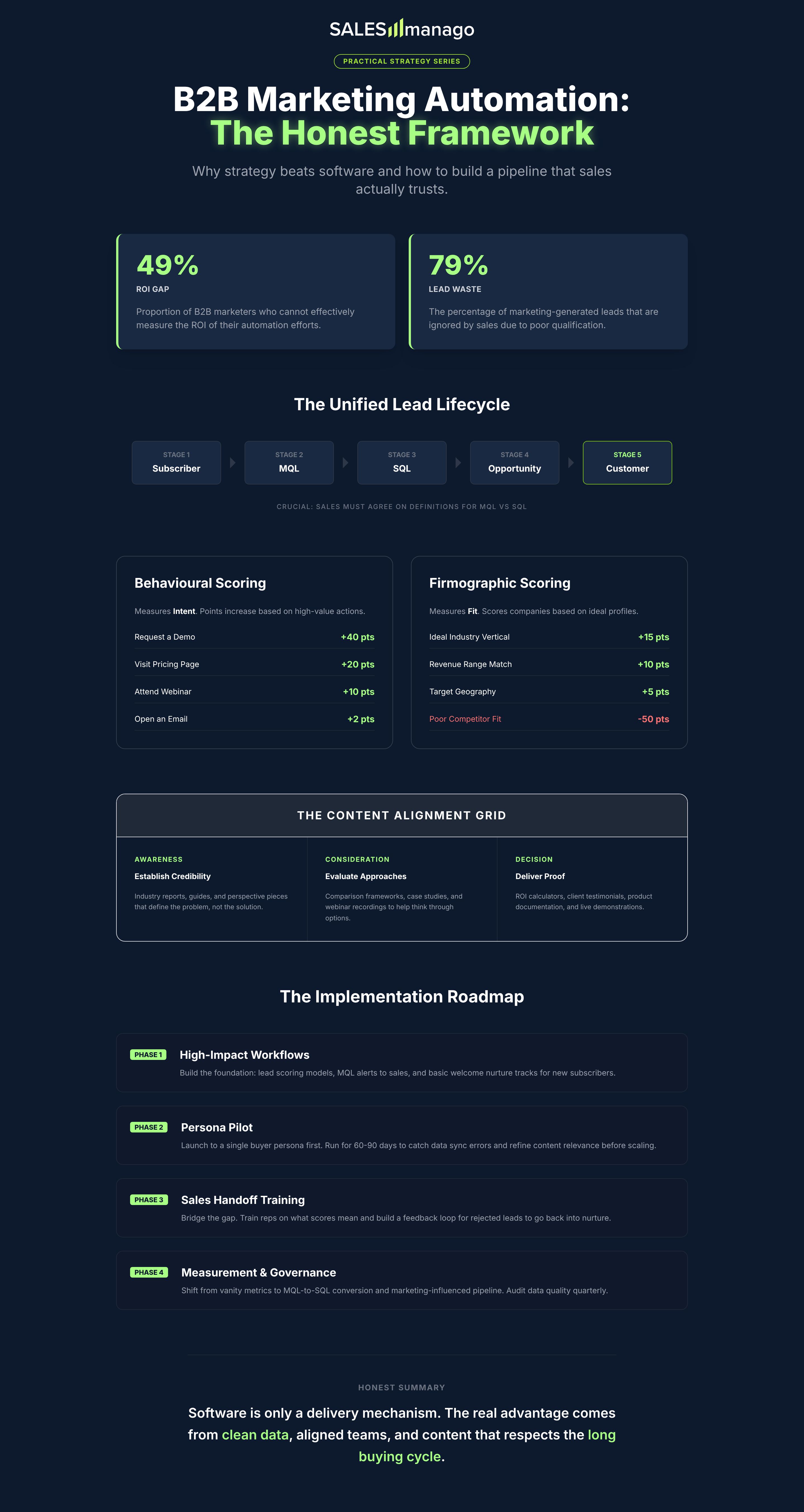
B2B leads move through distinct stages. Your automation needs to treat them differently at each one. Obvious in theory. Almost universally ignored in practice.
Subscriber: Someone who gave you an email address. They’re curious. Nothing more. Don’t send them a demo request.
Marketing Qualified Lead (MQL): Shows enough engagement to be worth nurturing. Downloaded content, attended a webinar, visited your pricing page twice. Still not ready for sales.
Sales Qualified Lead (SQL): Marketing has determined this person matches your ideal customer profile AND is showing buying intent. Now they’re worth a sales conversation.
Opportunity: Sales has engaged, there’s a real deal on the table. Marketing’s job here shifts to supporting sales with relevant content, not bombarding the prospect with automated emails.
Customer: They bought. Your automation job isn’t done. It’s changed. Now you’re focused on onboarding, retention, and expansion.
Here’s where most B2B marketing automation strategies collapse. Marketing sends a lead to sales. Sales doesn’t follow up, or follows up badly, or says the lead wasn’t qualified. Marketing thinks sales is lazy. Sales thinks marketing sends rubbish leads. Nothing gets fixed because nobody agreed on definitions in the first place.
Before you build a single workflow, sit down with sales and agree on:
What behaviour makes someone an MQL? Be specific. “Engaged with our content” isn’t a definition. “Downloaded two or more resources AND visited the pricing page within 30 days” is.
What makes an MQL become an SQL? Firmographic fit plus intent signals. Define both. Write them down. Get sales to sign off.
What happens when sales rejects a lead? It goes back into nurture, not into a black hole. Build that loop into your automation from day one.
This conversation is uncomfortable. Have it anyway.
Garbage data in, garbage automation out. For B2B specifically, you need:
Contact data: Name, email, job title, phone. Basic, but keep it clean.
Firmographic data: Company name, industry, company size, revenue range, geography. This tells you whether the company is a fit before you spend time nurturing them.
Behavioural data: What they’ve downloaded, which pages they’ve visited, which emails they’ve opened, which events they’ve attended. This tells you where they are in the buying journey.
Engagement history: Every touchpoint with your brand across every channel. Crucial for lead scoring.
If your CRM and marketing platform aren’t sharing this data in real-time, you’ve got a problem. Fix it before you build automation on top of it.
Lead scoring assigns point values to prospect behaviour and firmographic characteristics. When the total hits a threshold, that lead gets flagged for sales. Sounds straightforward. The implementation is where it gets interesting.
Get it right and sales actually trusts the leads marketing sends. Get it wrong and you’ll have sales ignoring your MQL alerts within three months, and a very uncomfortable conversation about why automation isn’t working.
Points go up when someone does something that signals buying intent.
High-intent actions get high scores. Visiting your pricing page? 20 points. Requesting a demo? 40 points. Opening an email? 2 points.
Low-intent actions get low scores. Following you on LinkedIn? 5 points. Attending a webinar? 10 points.
The exact numbers matter less than the logic. High-intent signals should dramatically outweigh passive engagement. Someone who visited your pricing page three times is more valuable than someone who opened 20 emails.
Also build in score decay. Someone who engaged heavily six months ago and then went completely dark isn’t the same as someone actively reading your content this week. Their score should reflect that. Most platforms handle this automatically. Use it.
Not every lead is worth the same effort regardless of their engagement level. A Marketing Manager at a 10-person startup engaging heavily with your content might score higher on behaviour than a VP of Operations at a Fortune 500 company who’s just started exploring. But the VP is probably worth more.
Build firmographic scoring on top of behavioural scoring. Company size, industry vertical, geography, revenue range. Add points for strong fit. Subtract points for poor fit.
Your ideal SQL looks like both. Good fit company, high engagement. That’s who you’re building the scoring model to surface.
Here’s what most guides skip. Your lead scoring model is a hypothesis until you validate it against historical conversion data.
Pull your last 50 closed deals. What did those prospects’ scores look like when they converted to SQL? What behaviour did they show in the 30 days before they became opportunities?
Then pull your last 50 leads that sales rejected. What did their scores look like? Where did they fall short?
Adjust your scoring model to match reality, not theory. Then review it every quarter, buying signals shift over time, and a model you built eighteen months ago probably doesn’t reflect how your best customers actually behave now.
As you tweak this, your team needs to decide on the specific criteria and scoring methods based on real conversion data to ensure your b2b marketing automation efforts are grounded firmly in reality.
Automation doesn't generate leads. Full stop. It processes and nurtures the leads that come in through your acquisition activities. What it does well is make sure no lead falls through the cracks once they've arrived.
Paid search captures demand that already exists. Someone searching "B2B marketing automation platform" is showing intent. Capture them.
Content marketing builds demand over time. Guides, reports, frameworks that answer questions your prospects are already asking. This article might be an example; let us know how we're doing.
Events remain one of the highest-quality B2B lead sources. Someone who spent an hour listening to your webinar is far more engaged than someone who downloaded a PDF.
LinkedIn is where B2B buyers actually spend time. Organic thought leadership from your team, combined with targeted paid campaigns, drives quality pipeline.
The mistake most B2B companies make is treating these channels as separate. Your automation platform should capture leads from all of them, tag the source, and feed that context into your lead scoring and nurture tracks.
The gate needs to be worth the friction. A 400-word blog post repurposed as a PDF isn't worth an email address. An original research report, a practical framework, a detailed industry benchmark? Those are worth gating.
Keep your forms short. Name and email gets you more leads than a 10-field form asking for budget and timeline. You can gather additional data progressively as engagement deepens.
One offer per landing page. One call to action. No navigation links that let people wander off.
Your headline should state the benefit, not describe the content. "How to Reduce Sales Cycle Length by 30%" outperforms "Download Our Sales Optimisation Guide" any day of the week.
Test your pages. Consistently. What works for one audience segment won't necessarily work for another.
Most B2B companies have buyer personas. Most of those personas are fictional characters built from assumptions rather than research.
A persona built on actual customer interviews is worth ten personas built in a workshop by people who've never spoken to a customer.
Interview your best existing customers. Ask them: what triggered your search for a solution? What other options did you consider? What nearly stopped you from buying? What do you wish you'd known at the start?
Interview prospects who didn't buy. Even more valuable. What didn't land? Where did you lose them?
For B2B, you're not building one persona per company. You're building personas for each stakeholder in the buying committee. The economic buyer (controls the budget), the technical buyer (evaluates the solution), the end user (lives with the decision), the champion (advocates internally for you).
They all have different priorities and they all need different content. Building one generic "decision-maker" persona and calling it done is why most B2B nurture tracks feel irrelevant to half the people receiving them.
Awareness stage: They know they have a problem but haven't defined it yet. They need educational content. Blog posts, industry reports, thought leadership. Not product information. Give them an itch. Open their eyes.
Consideration stage: They've defined the problem and are evaluating approaches. They need content that helps them think through options. Comparison guides, frameworks, case studies.
Decision stage: They've chosen an approach and are evaluating specific vendors. They need proof. ROI calculators, customer testimonials, detailed product information, demos, a night out with your sales team.
Map your content to these stages. Then build automation triggers that detect which stage someone is in based on their behaviour and serve them the right content.
The mistake most B2B marketers make is pushing decision-stage content (demos, pricing) at awareness-stage prospects. It feels pushy, it's not helpful, and it kills the relationship before it starts.
Email carries most of the weight in B2B marketing automation. But your prospects aren’t living in their inboxes.
Your welcome sequence sets the tone. Keep it short. Three to four emails that introduce your brand, establish credibility, and deliver genuine value. Not a sales pitch disguised as a welcome.
As mentioned, nurturing sequences need to match the buying stage. Awareness-stage prospects get educational content. Consideration-stage prospects get comparative content. Don’t jump straight to “book a demo” with someone who downloaded their first piece of content yesterday.
A/B test. Subject lines, send times, CTAs, content formats. B2B email performance varies enormously by industry and audience. What works for SaaS doesn’t necessarily work for manufacturing.
Segment your list. Job title, company size, industry, stage in the funnel, behaviour. Sending the same email to your entire database is a waste of time. Segmentation allows you to personalise your email content and timing to each recipient’s unique behaviors.
Send-time optimisation is worth using if your platform supports it. SalesManago adjusts sending time automatically based on each contact’s individual activity patterns, so every recipient gets the email when they’re most likely to open it, not when it’s most convenient for your scheduler. Sending to your whole list at 10 am Tuesday because that’s what the guide said? You’re leaving open rates on the table.
Paid search captures demand. Invest here for high-intent keywords related to your solution category.
Retargeting keeps you visible with prospects who’ve visited your site. B2B sales cycles are long. Someone who visited your pricing page three weeks ago and went dark might be ready to re-engage. Retargeting keeps you in their peripheral vision.
Account-based advertising lets you target specific companies with display ads. Particularly useful when you’re running ABM campaigns and want to surround a target account with consistent messaging across channels.
Social selling on LinkedIn. Your sales team should be active. Automation can support this with suggested content, engagement alerts, and CRM logging.
The key principle across all channels: they should feed each other. A prospect who clicks a LinkedIn ad goes to a landing page, downloads content, enters a nurture track, gets retargeted with relevant ads, and eventually reaches a lead score threshold that triggers a sales alert. That’s an integrated channel strategy. Most companies have the channels. Very few connect them properly.
Traditional demand generation casts a wide net and hopes for quality. ABM skips that entirely. You identify your ideal target accounts upfront, focus your resources on them, and build campaigns around specific companies rather than anonymous audiences.
If your deals are complex, high-value, and involve multiple stakeholders, ABM will almost always outperform broad demand generation on cost per acquisition. It's just more work upfront.
Start with firmographic filters. Industry, company size, geography, technology stack (if relevant), revenue range. Who do you win with most often?
Then add intent data. Which companies are actively researching your solution category right now? Platforms like Bombora track content consumption patterns to identify companies showing purchase intent. This is gold.
Combine firmographic fit with intent signals and you've got a target account list with an actual rationale behind it, rather than a spreadsheet someone built based on gut feel in 2022.
ABM automation works at the account level, not just the contact level. You're tracking engagement across multiple stakeholders at the same company and building a picture of account-level buying intent.
When multiple stakeholders from the same company engage with your content in a short window, that's a signal. Your automation should surface that to sales immediately.
Personalise your outreach at the account level. Reference their industry, their specific challenges, their company context. Generic nurture sequences don't work for ABM. The whole point is personalisation at scale.
Your biggest automation mistake after a deal closes? Stopping.
Post-sale automation should include onboarding sequences that reduce time-to-value. Check-in touchpoints that catch problems before they become churn risks. Feedback surveys at key milestones. Expansion campaigns when customers show signals of needing more.
Your existing customer base is your most valuable pipeline source. Expansions and referrals cost a fraction of new logo acquisition. Build automation that nurtures those relationships as carefully as you nurture new prospects.
You can have the best strategy in the room and still build automation that doesn't work. Usually because the data underneath it is a mess.
The most common B2B marketing automation failure is data. Duplicate contacts creating messy engagement histories. CRM and marketing platform out of sync. Behavioural data siloed from firmographic data.
Audit your data before you build automation on top of it. Specifically:
How many duplicate records exist in your CRM? More than you think.
Is your marketing platform syncing with your CRM? If not, your lead scores are based on stale data.
Are your behavioural and transactional datasets unified? Someone who visited your pricing page three times should show that in their CRM record, not just in your marketing platform.
Which of your marketing activities actually influences revenue? This is the question every B2B marketer struggles to answer.
First-touch attribution gives all credit to the channel that generated the lead. Easy to calculate, but it tells you nothing about what convinced them to buy.
Last-touch attribution gives all credit to the final touchpoint before conversion. Your bottom-funnel content looks brilliant. Everything that built trust over six months gets zero recognition.
Multi-touch attribution spreads credit across all touchpoints in the buyer journey. More honest, more complex, and it needs clean data across every channel to work properly.
For most mid-market B2B companies, a simple multi-touch model that gives meaningful credit to first touch, key middle touchpoints, and last touch is good enough. Don't let perfect attribution become an 18-month project that delays everything else.
Email open rates are a vanity metric. They tell you if your subject line worked on the day you sent it. That's it.
These are the numbers that actually matter:
MQL to SQL conversion rate: Are marketing leads actually converting to sales opportunities? If this is low, your lead scoring is off or your MQL criteria are too loose.
SQL to opportunity conversion rate: Are sales conversations turning into real deals? If not, either the leads aren't ready or sales needs better enablement (a whole other can of worms here).
Pipeline influenced by marketing: How much of your total sales pipeline touched a marketing activity at some point? This is the number that makes the case for marketing's contribution to revenue.
Customer acquisition cost by channel: Which channels generate customers most efficiently? Put more money there.
Customer lifetime value: Are the customers you're acquiring actually worth what it cost to acquire them? High CAC can be justified by high LTV. Low LTV cannot.
Review these monthly. Build dashboards. Stop running on gut feel about what's working.
Right. Platform selection. The section where every guide turns into a vendor comparison table.
Here's what to actually evaluate, rather than getting swayed by a demo that shows every feature at its absolute best.
CRM integration: Non-negotiable. Your marketing platform and CRM need to share data in real-time. If they don't, lead scores are stale, sales alerts are delayed, and your personalisation is built on incomplete information.
HubSpot works natively here because it's both the CRM and the marketing platform, convenient if you're already inside that ecosystem, but you're also locked in. Like a prison. Marketo integrates tightly with Salesforce but needs real technical resource to set up properly. For mid-market teams who want genuine CRM sync without a six-month implementation, it's worth evaluating platforms like SalesManago that are built specifically for your day-to-day.
Lead scoring and segmentation: Scores and segments should update as behaviour changes, and not manually either, not overnight in a batch process, in real-time. If a prospect hits your pricing page at 4pm, sales should know before end of day.
Multi-channel capability: Email, SMS, ads, on-site personalisation. B2B buyer journeys span multiple channels. Your platform should too.
AI personalisation: The gap between platforms is widening here. Platforms that predict the best next content, optimise send times individually, and use machine learning for lead scoring are making rules-based platforms look like they're running on Windows 95.
GDPR compliance tools: Consent management, data retention controls, right-to-erasure capabilities. If you're operating in Europe, this isn't just nice-to-have.
Marketo and HubSpot Enterprise are excellent. They're also expensive, complex to implement, and built for organisations with dedicated marketing operations resource.
If you're mid-market with a lean team, you need a platform that's powerful enough to do the job without requiring a consultant to configure every workflow. Evaluate platforms on ease of use alongside feature depth.
Request demos. Actually use them, don't just watch a presentation. Ask specifically about how long implementation takes. Ask for references from companies your size.
And be honest about your internal capabilities. A platform with sophisticated AI features is useless if nobody on your team has time to learn how to use them.
Right. You've got your strategy, your platform, your data (relatively) clean. Here's the build sequence.
Don't try to build everything at once. You'll build nothing properly.
Start with:
Lead scoring model (foundation for everything else)
MQL alert to sales (the most important handoff)
Basic nurture track for new MQLs (3-5 emails, educational content)
Re-engagement campaign for cold leads (quarterly at minimum)
These four workflows drive the most pipeline impact for the least implementation effort. Get them right before you add complexity.
Don't launch automation to your entire database on day one. Pick one buyer persona. Build the workflows for that persona. Run it for 60-90 days. Measure. Adjust. Then expand.
Piloting catches problems before they affect your whole database. It also gives sales a chance to see the approach working on a small scale before you ask them to trust it completely.
Your automation sends an MQL alert to sales. Whether anything useful happens next depends entirely on whether sales understands what that alert actually means.
Train them. Explain the scoring model. Show them what a high-quality MQL looks like versus a low-quality one. Tell them what to do when they reject a lead. Build feedback loops so marketing learns from those rejections.
Do it when you launch. Refresh it every quarter. Sales turnover is real and new reps won't magically understand your scoring model.
Appoint someone who owns the automation strategy. Not jointly owned between marketing and sales. One person accountable.
Set SLAs for lead response times. If marketing sends a sales-ready lead and sales takes 5 days to follow up, the lead is cold. Define response time expectations and measure against them.
Schedule quarterly reviews. What's working? What's not? What needs to be updated? Automation that isn't reviewed becomes the automation graveyard we talked about earlier.
Document everything. Workflow logic, scoring rules, segment definitions, content mapping. When the person who built it leaves, you need to be able to understand what they built and why.
Here's the part nobody lets you in on when they're selling you on automation: the platform shouldn't write the content. You should.
This is where more implementations stall than people admit. Teams build sophisticated nurture workflows and then fill them with mediocre blog posts repurposed as PDFs. The automation fires perfectly. The content goes nowhere.
Your content has to match the buying stage and the persona. A prospect who just realised they have a problem doesn't want a demo. Someone comparing vendors doesn't want a beginner's guide. Get this wrong and your automation is just sending irrelevant emails on schedule. Here's what each stage actually needs:
Awareness stage: Educational content that addresses the problem, not the solution. Industry reports, guides, perspective pieces that establish credibility.
Consideration stage: Content that helps prospects evaluate approaches. Comparison frameworks, detailed how-to guides, webinar recordings, case studies.
Decision stage: Proof content. Customer testimonials with specific results. ROI calculators. Detailed product documentation. References.
Before you build automation sequences, audit what content you actually have for each stage and each persona. You'll probably find you have lots of awareness content, some consideration content, and very little decision-stage content.
Build to fill the gaps. Then build the automation.
Store approved content in a centralised library. Use consistent naming conventions. Make it easy for anyone building workflows to find what they need. Sounds administrative. Saves enormous amounts of time.
Before you launch, confirm:
Strategy:
Sales and marketing have agreed on MQL and SQL definitions
Lead lifecycle stages are documented
Buyer personas are built from real customer research
Buyer journey is mapped with content assigned to each stage
Data:
CRM and marketing platform are syncing in real-time
Duplicate records have been cleaned
Consent records exist for all contacts being marketed to
Behavioural and firmographic data are unified
Automation:
Lead scoring model is built and validated against historical data
Score decay is configured
MQL alert workflow is active and tested
Basic nurture tracks exist for each persona
Re-engagement campaign is configured for cold leads
Post-sale onboarding automation is in place
Measurement:
Revenue attribution model is configured
KPI dashboards are built (MQL to SQL rate, pipeline influenced, CAC by channel)
90-day review is scheduled
Governance:
One person owns the automation strategy
Sales SLA for lead response time is agreed and documented
Quarterly review cadence is in the calendar
All workflows are documented
If more than five of these are missing, you're not ready to launch. Fix the gaps first.
B2B marketing automation works. Companies that implement it properly generate more qualified pipeline, waste less sales time on poor-fit leads, and build better relationships with prospects over long buying cycles.
Getting there takes more than buying a platform and activating templates. You need a real strategy, clean data, teams that actually agree on definitions, content worth sending, and someone who owns the whole thing.
Most guides skip the hard parts. This one didn't.
Start with the foundation. Lead scoring, MQL definition, sales alignment, basic nurture. Get those right. Measure them. Prove the model works on a small scale.
Then build.
The companies that do this properly generate more pipeline. They build a competitive advantage that's genuinely difficult to replicate. The strategy, the content, the clean data, and the team that actually uses all of it together? That's what competitors can't copy overnight.
That takes time. It's worth it.



Google "what percentage of loyalty programs fail" and you'll get a wider range than the Andes (world’s longest mountain range for those of you who failed Geography). Depending where you read anywhere from 20% to 97%. That tells you two things. First, nobody really agrees on what "fail" even means. Second, quite a lot of loyalty programs aren&...
You’ve seen the slide before. You know the one with your brand in the middle, channels radiating outward like a proud little sun. Email, SMS, web push, social, paid ads, on-site personalisation, maybe a loyalty program if you're feeling ambitious. It says "

This month isn’t about being fooled by the next massive industry panic or buying into stressful, hyper-complex tech trends. Low-friction joy? Welcome to the era of Treatonomics.