Growth Hack Series: One Automation That Boosts CLV

When working in an eCommerce marketing team you have plenty of metrics to observe: AOV, CR, RPV, CAC, CTR, CPC and a few other cool sounding acronyms. But sometimes the most important data you need is hidden under simple questions. “How many first-time buyers became second-time buyers last month?” — and the room usually goes quiet.
That silence is expensive.
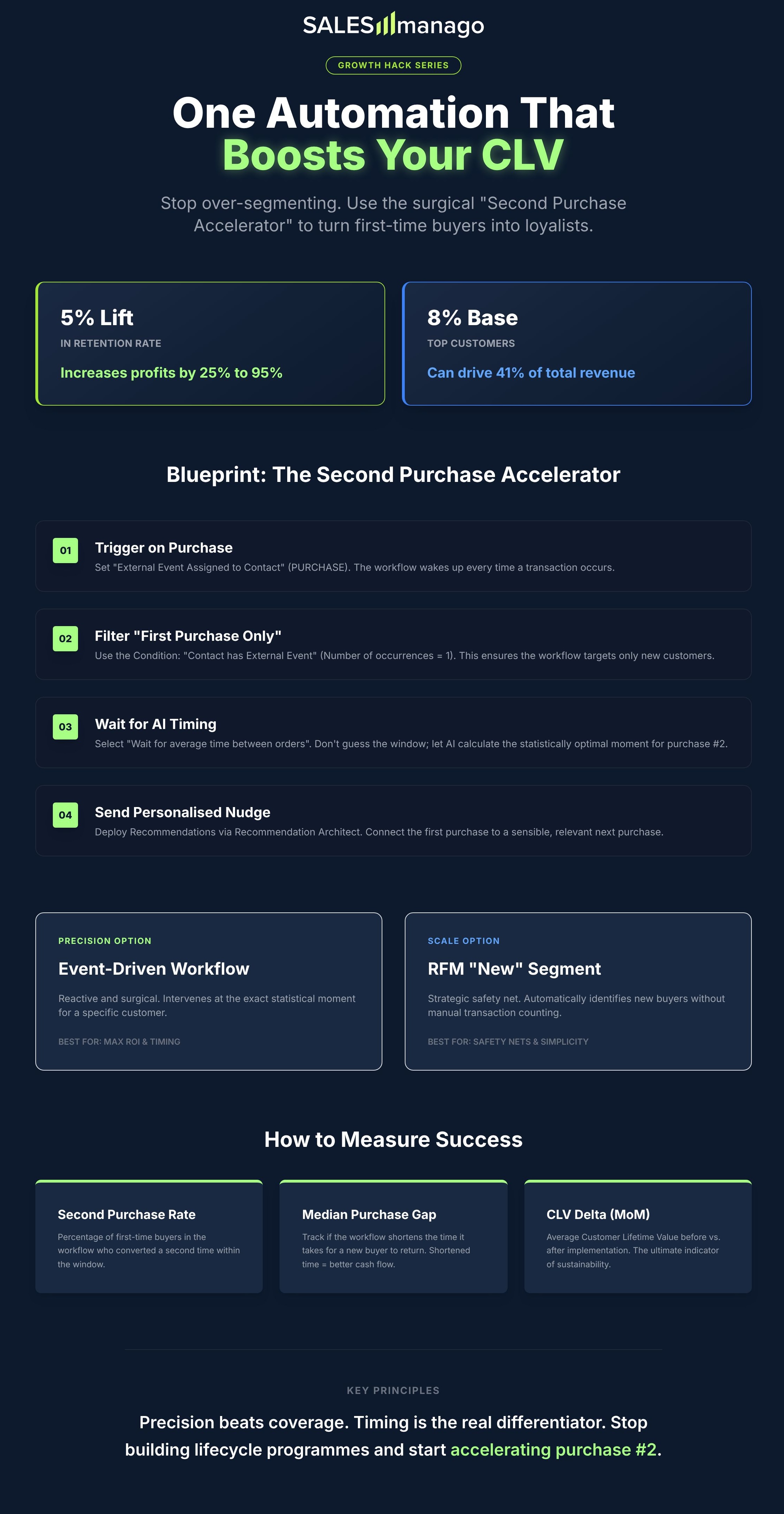
Because the second purchase isn’t “nice retention work” that happens by accident, but it is the point where CLV (another cool sounding acronym) starts meaning something, becomes strategy that usually trumps all other 3-letter metrics, as it tells you how sustainable your business is, beyond next quarter KPI meeting. According to Bain, it is simple: a 5% retention lift can increase profits by 25% to 95%. And data from Smile.io’s network suggests that just 8% of customers can drive 41% of revenue.
So here’s the hack: build one workflow that only targets customers who have made exactly one purchase, then hit them when they’re most likely to order again.
No sprawling lifecycle programme. No over-segmentation. One automation, one job: get purchase #2.

Okay, so your first thought is to go big and fix what is wrong with this world, or at least with your retention. But stop right now! Stop trying to “improve retention” in general. You’re not building a six-month nurture campaign. You’re not arguing about whether Day +7 is better than Day +10.
You are doing two things:
Identify the first purchase with high precision.
Send a second-purchase nudge at the moment it has the best chance of landing.
SALESmanago gives you both pieces inside Workflow:
External Event assigned to Contact to trigger on purchase events.
Contact has External Event to check the customer’s purchase history and filter first purchase only.
Wait for average time between orders to stop guessing timing and let the platform choose the window.
Before you build anything, you need to ensure that you have all necessary ingredients for your retention potion. You need to confirm two truths:
Your store sends purchase data to SALESmanago as an External Event (typically PURCHASE).
That event is assigned to the contact (so Workflow can count it).
If those aren’t true, the workflow can’t “see” purchase #1, and nothing below will behave as advertised.
Go to: Automations→ Workflows → + New Workflow.
Name it something that makes reporting obvious later, e.g. Second Purchase Accelerator.
From Events, drag External Event assigned to Contact onto the canvas.
Connect it to Start.
In Event settings, select the event type PURCHASE (or whatever your integration uses for purchase events).
Result: the workflow wakes up every time someone buys.
Now you do the one thing most teams skip: you exclude everyone except brand-new buyers.
From Conditions, choose Contact has External Event.
Configure it to check purchase history:
Event type: PURCHASE
Number of occurrences:equals 1 (or your equivalent “first purchase” logic)
Connect it to the trigger event.
What happens next:
YES path (green): only customers whose purchase count is exactly 1 continue
NO path: end the workflow (Finish), because this automation is not for repeat buyers
Why this matters: it turns the workflow into a scalpel. No tag maintenance. No “maybe first purchase”. It’s deterministic.
(If you want to go deeper into the condition’s capabilities and criteria, the support doc spells out how external-event conditions are evaluated.)
This is where the workflow stops behaving like “marketing automation as usual”.
Add Wait (Other nodes).
Select Wait for average time between orders.
SALESmanago introduced this option specifically to reach contacts when they’re most likely to place an order, including strategies to continue before or after the average window depending on your goal.
Practical configuration idea:
For replenishable products: continue slightly before the average time (pre-empt “I ran out”)
For discretionary products: continue slightly after the average time (recover “I forgot”)
You’re no longer debating generic “best practices”. You’re using a timing model.
Now add the action that actually drives purchase #2.
From Actions, choose Send email to Contact (or SMS / Web Push if that’s your strongest channel).
Select a prepared template.
Make the message do one thing: connect the first purchase to a sensible next purchase.
The easiest “high relevance with low effort” move is recommendations, and SALESmanago gives you a ready-made framework via Recommendation Architect.
Add Finish at the end of the YES path.
That’s intentional. Your workflow is a single intervention aimed at one behavioural milestone.
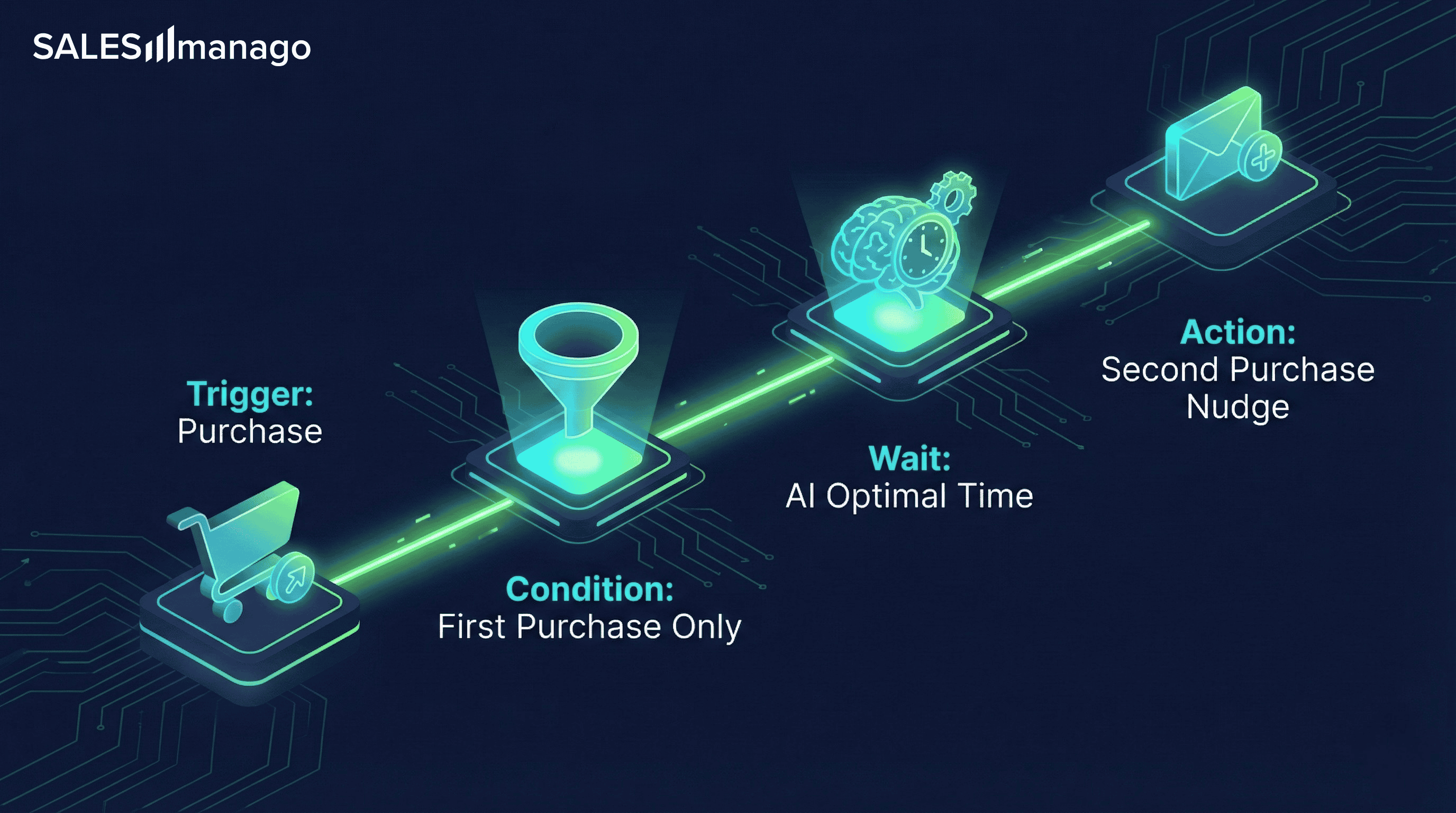
The workflow described above is intentionally surgical: it reacts to a specific event (the first purchase) and intervenes at a specific moment (the statistically optimal time for purchase #2).
But not every team needs or can support this level of precision from day one.
That’s where RFM Marketing Automation can act as a complementary or transitional solution.
RFM (Recency, Frequency, Monetary value) automatically groups customers based on their purchasing behaviour. One of these groups is typically “New”. Those are customers who have made their first purchase recently but haven’t yet established a repeat pattern.
From a practical standpoint, this means:
You don’t need to build event-based workflows
You don’t need to calculate transaction counts manually
The system continuously refreshes the segment for you
You can then attach simple, automated actions to the “New” segment:
a dedicated second-purchase campaign,
a time-limited incentive,
or a hand-off to another stage of your funnel.
The trade-off is precision.
RFM works at segment level, not at moment level. It won’t tell you exactly when a given customer is most likely to buy again, only that they belong to a group where a second purchase should be encouraged.
That’s why, in the context of this article, RFM is best positioned as:
a strategic safety net for scale,
or a lighter alternative for teams not yet ready for event-driven workflows,
while the “Second Purchase Accelerator“ workflow remains the sharper tool when timing and relevance matter most.
All right, you built your workflow with the precision of a rocket engineer, you deploy it and now you have to wait for the results. But how to measure them exactly? How are you going to know that you succeeded and landed on Mars not in your neighbour’s pool?
Well, one of the quiet advantages of focusing on the second purchase is that measurement becomes simpler, not harder.
You don’t need a complex attribution model or a multi-touch debate. You’re tracking a behavioural milestone.
Three numbers are enough.
This is your primary success metric.
Look only at:
customers who completed exactly one purchase,
entered the workflow,
and then made (or didn’t make) a second purchase within a defined window.
Even a small absolute increase here matters. Why? Because industry data shows repeat buyers generate a disproportionate share of revenue - up to 40% more!
Average time to second purchase is misleading. One exception spoils the average.
The median tells you something far more useful:
How long it usually takes for a first-time buyer to become a repeat buyer.
If your workflow shortens this time, even without increasing overall conversion rate, you’re improving cash flow, predictability, and downstream CLV.
You don’t need a perfect CLV model to justify this hack.
A general comparison works:
average CLV before introducing the workflow,
average CLV after, measured month-over-month.
Why is this okay? Because retention economics are asymmetrical: increasing retention by just 5% can lift profits by 25%–95%. And the second purchase is one of the strongest leading indicators of that retention.
If someone asks why you’re “so focused on purchase #2”, the answer is simple: it’s where CLV stops being hypothetical.
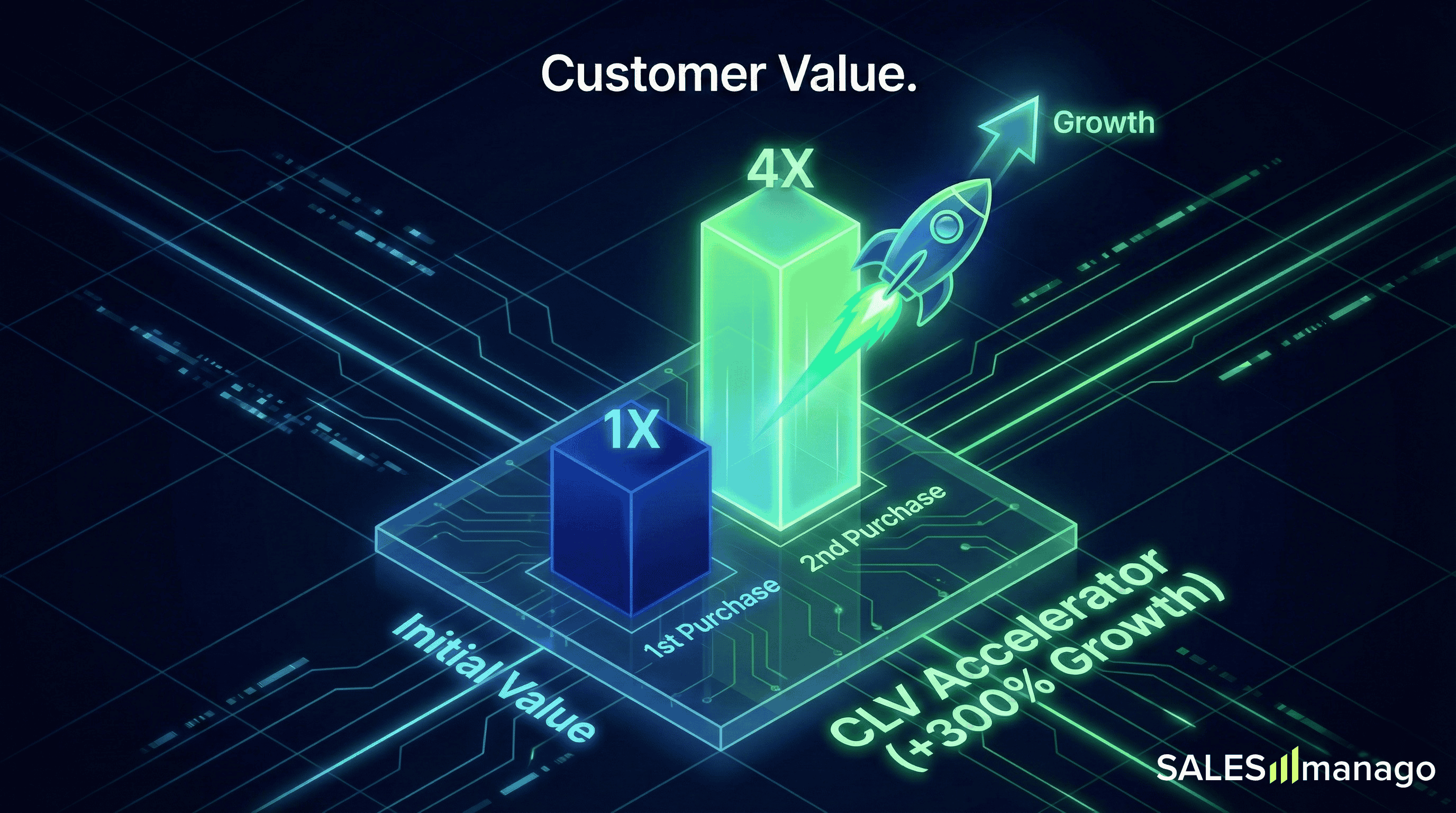
One piece of general advice - don’t try to build Rome in a day. It won’t happen anyway, and the only thing you will build is frustration. So, treat this hack not as a retention programme that will manage the entire customer lifecycle.
Treat it for what it is: a milestone capture, a focused intervention at the most leverage-heavy point in early customer behaviour.
Grab a few principles that will make it work:
Precision beats coverage. Filtering customers with exactly one purchase keeps the automation clean, relevant, and defensible.
Timing is the real differentiator. Most retention automations fail not because of content, but because they show up at the wrong moment. AI-based timing removes guesswork from the equation.
Relevance doesn’t require over-segmentation. Product recommendations, especially cross-sell based on the first purchase, deliver contextual relevance without building a new segmentation universe from scratch.
Putting this simply: this hack works because it’s narrow, behavioural, and honest about what actually moves CLV.


Google "what percentage of loyalty programs fail" and you'll get a wider range than the Andes (world’s longest mountain range for those of you who failed Geography). Depending where you read anywhere from 20% to 97%. That tells you two things. First, nobody really agrees on what "fail" even means. Second, quite a lot of loyalty programs aren&...
You’ve seen the slide before. You know the one with your brand in the middle, channels radiating outward like a proud little sun. Email, SMS, web push, social, paid ads, on-site personalisation, maybe a loyalty program if you're feeling ambitious. It says "
This month isn’t about being fooled by the next massive industry panic or buying into stressful, hyper-complex tech trends. Low-friction joy? Welcome to the era of Treatonomics.