#Growth Hack Series: Avoid "Zero-result" Dead Ends Using AI Product Discovery

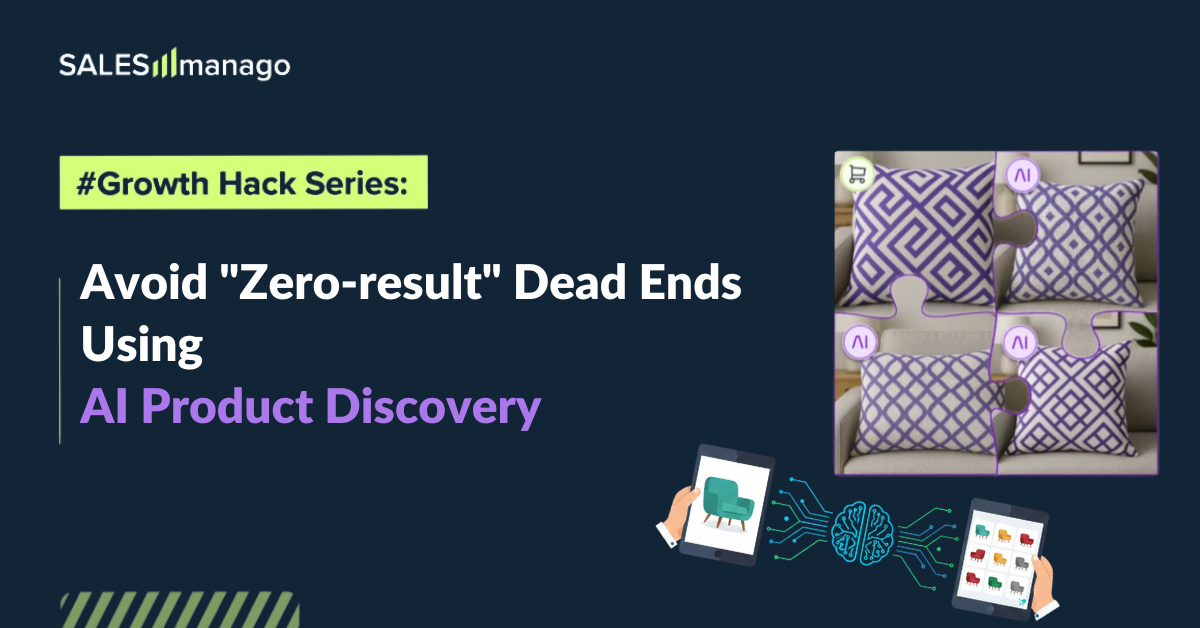
We have all been there. You have a specific image in your head: a mid-century modern armchair in teal velvet, or a dress with a very specific floral pattern. You go to an online store and type "blue chair" or "flower dress". The results? Hundreds of irrelevant items that force you to scroll for twenty minutes. Or worse: "No results found."
You can call it the "text-search friction" gap, or just another Thursday online.
The reason for this is well-known. Standard search bars rely on keywords and metadata, and you build your inventory around these two major characteristics. However, if your customers don’t search exactly the same words you used to tag your product, the search fails, or even worse, it doesn’t meet users’ expectations. Which easily results in irritation, abandonment and visiting competition. Of course, you can have an imaginative product content manager who will add dozens of tags to the product cards, hoping to finally hit the spot. And it might work when your inventory is relatively small, but when you juggle hundreds or thousands of products, the effectiveness of this approach will decline over time and the costs of it will rise. Moreover, in an era where shopping inspiration comes from Instagram, Pinterest or TikTok, text-based search is becoming an obstacle anyway. The friction between seeing something you love and finding it in a store is where conversion is lost.

Let’s take a look at how people buy goods and services these days. Not long ago platforms focusing on visual aspects of the content, like Instagram, Pinterest or TikTok, were just powerful tools in the hands of marketers using them to promote their brands. But now they are often super weapons in the hands of sales teams! Data doesn't lie:
Social commerce already represents 19% of global e-commerce and is growing at 3× the overall market rate, driven by double-digit adoption and platform-native checkout.
TikTok Shop doubled its US revenue in a single year, reaching approximately $15.8B in 2025, becoming the fastest-growing social commerce platform in the market.
Europe is following the same trajectory, with social commerce growing 25–30% annually, despite stricter regulation and slower platform rollout compared to the US.
To stay relevant, eCommerce businesses need to embrace this shift and respond to it.
Ok, so what do we have on the table?
We want to stop losing people because of missed keyword searching.
We want to help them find what they need without needing them to type too much. Let them use eyes only - they are used to it with social media anyway.
To make it happen we need to help them easily discover our product. We also need to personalise this experience for them, and ideally - automate it, as we don’t have an army of personal counsellors. So we need to apply AI for that.
And for these reasons we’ve introduced a specific solution: AI Product Discovery.
Instead of forcing users to guess the right keywords, you deploy a visual intelligence layer. This strategy uses AI to analyse the actual pixels of your inventory—understanding shapes, patterns, and colours just like a human eye would. By combining visual search (uploading photos) with Visually Similar Recommendations (suggesting aesthetic twins), you create a "see it, shop it" loop that captures high-intent buyers instantly.
You don’t need a team of data scientists to activate visual intelligence. The heavy lifting is done by the SALESmanago engine; your job is simply to guide it. Here is how to turn these features on using the tools you already have.
Before the AI can match products, it needs to "see" them. The system analyses the images currently in your product catalogue.
What to do: Whether you import products via XML or the API v3, ensure your product feed is healthy. The AI specifically looks at the mainImageUrl (the primary photo) to understand the shape, colour, and pattern of an item.
The benefit: By ensuring these links are valid during your standard product updates, the AI automatically indexes your inventory. You don't need to manually tag products as "red" or "floral"—the system sees the pixels and does it for you.
This is the core of the hack: replacing generic suggestions with "Visual Twins" to keep customers engaged on the Product Page.
How to enable it:
Navigate to the Recommendation Architect in your dashboard and click Create New.
Select Strategy: In the Recommendation Architect, select a base scenario that matches your marketing strategy, for example, “Recently viewed products” or “Products left in cart”. Then, use the modifier: Replace with similar products, choosing the option: Based on appearance
Refine: Use the Filters step to exclude "Out of Stock" items (so you don't recommend products people can't buy). You can also lock recommendations to the same Category to ensure a dress is matched with other dresses, not shoes.
Design: Use the built-in visual editor to style the widget so it matches your website’s branding (fonts, buttons, colours).
The result: When a user views a product, the widget instantly displays alternatives that share the same visual DNA, keeping the user in the discovery loop.
Visual similarity covers the "look," but you also need a strategy for general discovery, especially for "No Results" pages or generic categories.
How to enable it:
Create another campaign in the Recommendations menu.
Select strategy: Choose "AI Recommendations" from the list of strategies in Recommendation Architect.
Configure: This model predicts what a user might want based on their behavioural footprint and what similar customers bought.
Deploy: Set this widget to appear on your "404" or "Zero Search Results" pages.
The benefit: If a specific visual match isn't found, this system steps in to offer hyper-relevant suggestions based on data trends, preventing the customer from hitting a dead end and leaving the site.
Implementing AI Product Discovery transforms your customer's journey from a frustrating keyword guessing game into a seamless visual experience. By eliminating search dead ends and bridging the gap between inspiration and inventory, you not only reduce bounce rates but also capture high-intent revenue that standard text search misses. This strategy removes friction, ensuring customers find their perfect match instantly and turning their visual intent into sales.



Google "what percentage of loyalty programs fail" and you'll get a wider range than the Andes (world’s longest mountain range for those of you who failed Geography). Depending where you read anywhere from 20% to 97%. That tells you two things. First, nobody really agrees on what "fail" even means. Second, quite a lot of loyalty programs aren&...

You’ve seen the slide before. You know the one with your brand in the middle, channels radiating outward like a proud little sun. Email, SMS, web push, social, paid ads, on-site personalisation, maybe a loyalty program if you're feeling ambitious. It says "

This month isn’t about being fooled by the next massive industry panic or buying into stressful, hyper-complex tech trends. Low-friction joy? Welcome to the era of Treatonomics.