The Growth Hacking Series: Stop Customer Churn With AI Crystal Ball

In the growth game, we spend a ridiculous amount of energy flirting with strangers. We obsess over the "new acquisition" hunt, yet often treat our existing customers as static assets. As long as they don’t hit "Unsubscribe," we assume they are fine.
But the real killer in eCommerce isn't the loud complaint—it’s the “Silent Churn”. It is the customer who used to browse every Tuesday but has slowly drifted into the digital fog. By the time your "90-day Win-back" email fires, you’ve already lost. To keep them, you must intervene while they are still "warm." You don’t need a literal crystal ball for this; you need the AI-powered Predictive Analytics. By leveraging advanced machine learning to spot microscopic shifts in engagement, you can deploy a pre-emptive strike before a lapse becomes a permanent exit.

While acquisition gets the spotlight, long-term health depends on retention. If your database is growing but your repeat purchase rate is stagnant, you aren’t scaling—you’re just replacing lost revenue at a high cost.
Here is why "Silent Churn" is the single greatest threat to your eCommerce margins:
The Profit Multiplier: A 5% boost in retention can increase profits by 25% to 95%.
The Cost of Acquisition: Brands now lose an average of $29 for every new customer acquired due to rising ad costs.
The High Rate of Defection:Average annual churn hovers between 70% and 77%.
The AI Advantage: Existing customers are 50% more likely to try new products and typically spend 31% more per transaction.
Unchecked churn creates a cycle of expensive replacement. If customers don’t return for a second or third transaction, you aren't building a sustainable business, you’re absorbing a net loss. Sustainable growth is impossible when the cost of replacing a customer consistently exceeds the margin of their first order. Ignoring churn also eliminates your most profitable revenue stream, effectively handing high-margin opportunities to your competitors.
The solution isn't to send more emails, but to change when you send them. SALESmanago’s predictive solution is powered by Artificial Intelligence and machine learning models. The platform utilises complex algorithms to analyse historical transactional and behavioural data (such as website activity and purchase history) to identify patterns invisible to the human eye.
By building AI models that accurately estimate future events, the system calculates Churn risk for individual contacts. This allows you to identify high-risk segments in the "transition phase" and deploy targeted incentives that secure the relationship before the exit happens.
Before launching your rescue automation, you need to see how many customers are currently in the "danger zone."
Navigate to Insights → Artificial Intelligence → Predictive Analytics.
Locate the Predictive Modeling: Churn section.
Here, the SALESmanago AI categorises your database into four risk levels: Low, Medium, High, and Very High. Your mission is to target those in the last two groups.
Now, create a background process that utilises these AI models to trigger a reaction.
Go to Automations → Automation Processes → Workflow → + New Workflow.
Start with a Start element connected to a trigger event, such as Website visited.
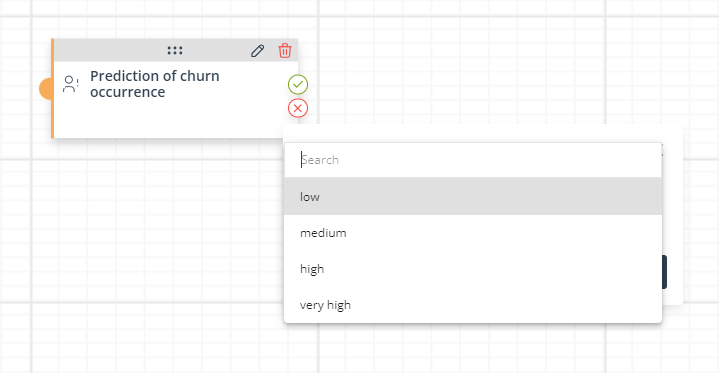
Add the yellow Condition tile: Prediction of churn occurrence.
Configure the condition to only pass through contacts that the AI identifies as falling into the High or Very High churn risk segments.
Once a "pre-churn" customer is identified, you must provide an immediate incentive to return.
From the "TRUE" path (green link) of your condition, add an Action: Send email to Contact.
Select a "Win-back" template featuring a compelling, time-limited offer.
Pro Tip (Omnichannel): If your audience is mobile-first, swap or supplement the email with a Send text message (SMS) or a Web Push notification to ensure high visibility.
Ensure all tiles are linked with arrows to create a logical flow ending with a Finish element.
Save the process and set the status to Active. Your AI-driven guardian is now working 24/7 to protect your revenue.
Deploying the "AI Crystal Ball" hack shifts your marketing from guesswork to precision, delivering immediate operational advantages:
AI-driven Identification: You catch at-risk customers while they are still visiting your site, rather than waiting for months of silence.
Segmented Incentives: You stop "blanket discounting" and reserve high-value vouchers strictly for the AI-identified High and Very High risk groups.
Omnichannel Resilience: Using SMS or Web Push ensures your rescue offer is seen even by those who ignore their inbox.
Automated Revenue Recovery: The system works 24/7, reclaiming revenue that would otherwise have been lost to competitors.
The transition to predictive retention is a fundamental shift in how a company scales. In an era of record-high acquisition costs, protecting your existing database with Machine Learning is the most reliable way to ensure long-term profitability.
By using SALESmanago’s AI tools, you aren't just sending emails; you are actively managing your Customer Lifetime Value (CLV). This approach ensures your budget is spent where it has the highest impact—preventing the exit of high-value customers while preserving margins among the loyal. Ultimately, the "Crystal Ball" hack turns your retention strategy into an AI-powered growth engine for a more resilient, data-driven eCommerce business.
| Feature | Traditional "Win-back" | AI-predictive "Crystal Ball" |
|---|---|---|
| Trigger | Time-based (e.g., 90 days since last buy) | Behaviour-based (AI detects intent shifts) |
| Timing | Reactive (after the customer has left) | Proactive (before the customer leaves) |
| Precision | One-size-fits-all | Personalised risk scoring (Low to Very High) |
| Margin Impact | High (discounts sent to everyone) | Low (discounts reserved for high-risk only) |
| Channel | Usually Email only | Omnichannel (Email, SMS, Web Push) |
| Goal | Resuscitation | Prevention |
The SALESmanago AI doesn’t just look at the last purchase date. It uses machine learning to analyse "micro-signals," such as a decrease in website visit frequency, shorter session durations, or a drop-off in email engagement. When these patterns match historical "pre-churn" behaviour, the AI flags the account immediately.
Not at all. The machine learning models are pre-built into the SALESmanago platform. The "AI Crystal Ball Hack" is designed for marketers; you simply access the Predictive Analytics dashboard and use the ready-made "Prediction of Churn" condition in your Workflow.
Actually, it’s the opposite. Traditional campaigns often send discounts to people who would have bought anyway. Because our AI identifies specific risk levels, you can set your Workflow to only trigger a discount for "High" or "Very High" risk customers, while leaving "Low" risk customers to purchase at full price.
While Churn Prediction estimates the probability of a customer leaving, Customer Lifetime Value (CLV) estimates the total revenue a customer will generate. Combining both allows you to prioritise "VIP" customers who are at risk of leaving, ensuring your highest-value assets are protected first.
It works for both. In B2B, the "Silent Churn" is often even more dangerous because the sales cycles are longer. The AI adapts its learning to your specific transactional patterns, whether your customers buy once a week or once a quarter.
The machine learning models thrive on historical data. Usually, once you have a solid baseline of transactional and behavioural history in the system, the AI can begin generating accurate predictions. The more data it processes, the more precise the "Crystal Ball" becomes.


Google "what percentage of loyalty programs fail" and you'll get a wider range than the Andes (world’s longest mountain range for those of you who failed Geography). Depending where you read anywhere from 20% to 97%. That tells you two things. First, nobody really agrees on what "fail" even means. Second, quite a lot of loyalty programs aren&...

You’ve seen the slide before. You know the one with your brand in the middle, channels radiating outward like a proud little sun. Email, SMS, web push, social, paid ads, on-site personalisation, maybe a loyalty program if you're feeling ambitious. It says "
This month isn’t about being fooled by the next massive industry panic or buying into stressful, hyper-complex tech trends. Low-friction joy? Welcome to the era of Treatonomics.