AI Marketing Automation for Mid-Market eCommerce: What Actually Works in 2026

Everyone's suddenly an AI expert. Your inbox is full of "revolutionary AI-powered marketing platforms" promising to 10x your revenue while you sleep. Your CEO forwarded you three articles about ChatGPT last week. And you're sitting here wondering: what am I actually supposed to do with all this?
Here's the truth nobody's saying out loud, most AI marketing automation talk is vendor hype dressed up as innovation. But underneath the noise, there's something genuinely useful happening. Let’s take a look at how to use it without needing a data science PhD or a Fortune 500 budget.
Want to know something the industry won't admit? Gartner revealed AI project failure rates at around 85% in 2023, and marketing automation is right there in the wreckage. Most companies jumped in because a vendor pitched them, not because they understood what problem they were solving. The hype cycle convinced everyone they'd be left behind if they didn't "do AI," so they did AI. Badly.
Let's cut through the nonsense.

Traditional marketing automation runs on rules you create. If someone abandons their cart, send email A. If they click, wait two days, send email B. You're the puppet master pulling strings based on "if this, then that" logic.
AI marketing automation flips this. Instead of you defining every possible scenario, machine learning algorithms spot patterns in your customer data and make predictions. They look at thousands of similar customers and calculate things like this person has an 82% chance of buying if we send them this specific offer at 2pm tomorrow via email rather than SMS.
So to put it in super simple terms. Traditional automation does what you tell it. AI automation learns what works and does that instead.
What AI marketing automation includes:
Predictive analytics (guessing what customers will do next)
Dynamic personalisation (changing content in real-time based on behaviour)
Automated optimisation (testing and improving campaigns without manual tweaking)
Intelligent segmentation (finding patterns you'd never spot manually)
Cross-channel orchestration (coordinating messages across email, SMS, web, mobile)
What it doesn't include:
Creative strategy (that's still your job)
Brand voice development (AI can mimic, not create)
Understanding your market positioning (requires human judgement)
Replacing your marketing team (despite what LinkedIn thought leaders claim; lucky me…)
| Traditional Marketing Automation | AI Marketing Automation | |
|---|---|---|
| How it works | Fixed rules: "If X happens, do Y" | Machine learning: Predicts outcomes and adapts |
| Personalisation | Segment-based (5-10 groups) | Individual-level (unique for each customer) |
| Optimisation | Manual A/B testing | Continuous self-optimisation |
| Decision making | You define every scenario | AI learns best actions from data |
| Setup complexity | Build every workflow manually | Define goals, AI figures out execution |
| Best for | Predictable customer journeys | Complex, multi-channel journeys |
| Data requirements | Basic segmentation data | Unified customer data across channels |
| Scaling | Linear (more workflows = more work) | Exponential (handles complexity automatically) |
| Human involvement | High (constant tweaking) | Medium (strategic oversight) |
You're collecting more customer data than ever. Website visits, email opens, purchase history, product views, cart additions, SMS clicks, mobile app behaviour. The average eCommerce customer touches your brand across 4-6 channels before buying.
Processing all that data manually? Impossible. Creating personalised experiences for 50,000 customers? Can't be done by hand. Knowing the optimal send time for every individual on your list? Definitely not without AI.
Three years ago, basic segmentation was enough. Today, your customers expect Amazon-level personalisation from every brand they touch. The bar moved. AI marketing automation is how mid-market companies keep up without hiring 20 data analysts.
But here's where most advice falls apart: it's written for massive companies with unlimited budgets and flipping dedicated AI teams. You're running a growing eCommerce business in Europe with a marketing team of 5-10 people. You don't have time for a six-month implementation or budget for consultants.
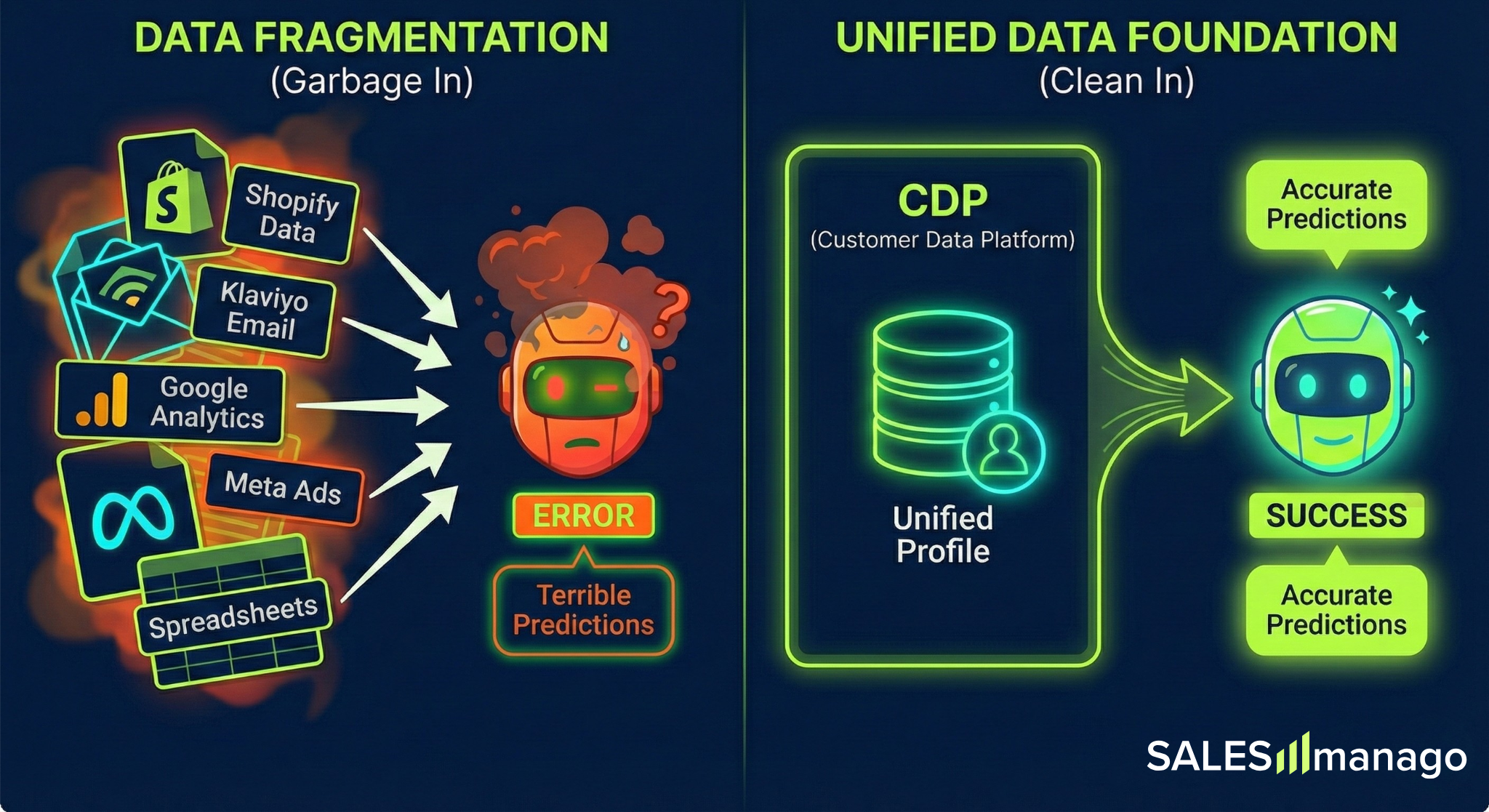
Here's why half of AI marketing automation projects fail: Garbag-… sorry, rubbish data in, rubbish results out (let's stick to the Queen’s English).
Unfortunately many vendors profit from this confusion. Sell the AI dream, downplay the data requirements, lock you into a 12-month contract, then blame your "legacy infrastructure" when it doesn't work. I've watched this play out dozens of times.
AI needs clean, unified customer data to work. Not data scattered across Shopify, Google Analytics, Meta Ads, and three different spreadsheets on Barry’s shared drive. Not customer records with five different email formats and conflicting purchase histories. Actually unified data where one customer record contains their complete journey.
This is where Customer Data Platforms (CDP) come in, and in some ways, why they matter more than the AI algorithms themselves.
A CDP collects data from every touchpoint (website, email, SMS, mobile app, customer service, point of sale), matches it to individual customer profiles, and creates a single source of truth. Real-time. Without you manually exporting CSVs every week.
Watch out though a lot of marketing automation platforms bolt AI onto fragmented data and wonder why the predictions are terrible. They'll optimise email send times based on incomplete information. Recommend products based on purchase data that's three days old. Segment audiences without knowing half their behaviour.
The platforms that are smashing it right now built the CDP first, then added AI on top. The data foundation matters more than the algorithm sophistication.
Think of it in four layers:
1. Data Collection Every customer interaction gets captured. Emma visits your site, views three dresses, adds one to cart, abandons it, opens your email two days later, clicks through, completes purchase on mobile. All recorded, all unified into Emma's profile.
2. Analysis Machine learning models process this data continuously. They spot that customers like Emma (viewed 3+ items, abandoned once, responded to email) have an 87% conversion rate when they receive a specific discount within 48 hours. They notice Tuesday mornings get 34% higher open rates for this segment. They predict Emma's likely to churn if she doesn't purchase again within 30 days.
3. Execution Based on these insights, the system automatically triggers actions. Emma gets that specific discount via email on Tuesday at 10am. After she purchases, she's added to a re-engagement workflow timed for 28 days from now. The AI picked the channel, the timing, the message, and the offer without you creating a workflow for this exact scenario.
4. Learning Emma clicked but didn't convert. The AI notes this, adjusts its prediction model, and tries a different approach next time. With every interaction across thousands of customers, it gets smarter.
Instead of building individual workflows your customers are actually teaching the system what good outcomes look like, then letting it figure out how to get there.
Enough theory. What does this look like for actual mid-market eCommerce brands?
Standard cart abandonment: everyone gets the same three emails on the same schedule.
AI version: The system knows Sarah abandons carts regularly but converts 70% of the time within two hours if she gets a mobile push notification (not email). Meanwhile, James needs three days and responds better to SMS with free shipping offers. Different customers, different treatments, automatically.
Basic recommendations: "Customers who bought X also bought Y."
AI version: The system tracks that in the last two weeks, customers viewing outdoor furniture on mobile between 7-9pm and then leaving the site have a 45% higher conversion rate when shown complementary items (cushions, outdoor rugs) in their next email rather than similar products. It adjusts recommendations in real-time based on context, device, time, and behaviour patterns.
Traditional approach: Send a "we miss you" email to everyone who hasn't purchased in 60 days.
AI version: The system calculates each customer's purchase cycle. For subscription products, it's predictable. For fashion, it varies by season and customer. Instead of arbitrary timeframes, it reaches out when each individual customer is actually likely to need something, often before they've even thought about it themselves (mind reading AI, wasn’t on my 2026 bingo).
You send one email campaign. But the product images, offers, and copy change for each recipient based on their browsing history, past purchases, predicted preferences, and real-time behaviour.
Person A sees winter coats because they viewed them yesterday. Person B sees accessories because they bought a coat last week. Person C sees completely different products because the AI spotted a pattern in similar customers' behaviour that suggests they'd convert better with an alternative category.
One email. Thousands of variations. Automatically.
Visitor lands on your homepage. AI checks: first-time visitor from mobile, browsed category X on competitor site (if you have the data), similar demographic to your best customers. Homepage instantly shows different hero image, different product collection, different call-to-action compared to what a returning customer on desktop would see.
No manual setup. No complex rules. The system learns what converts and adjusts.
Forget the six-month implementation timelines enterprise platforms love. Here's how mid-market eCommerce brands actually deploy AI marketing automation:
Start with baby steps (Week 1-2) Get your data unified. If customer information lives in five different systems, AI will fail. Connect your eCommerce platform, email tool, customer service system. Make sure customer records match across all of them.
Now you’re walking (Week 3-4) Pick one high-impact use case. Usually cart abandonment or product recommendations. Let the AI optimise this single workflow. Measure results. Learn how it behaves.
Now you’re running (Month 2-3) Add more use cases. Email send time optimisation. Predictive segmentation. Web personalisation. Each builds on the last.
Now you’re flying (Ongoing) Review what's working monthly. Feed the system better data. Adjust goals. The AI improves as it learns, but you still guide strategy.
The entire process? 30-90 days from start to measurable results. Not the 6-12 month implementations overkill vendors quote.
Why do most implementations drag on forever? Because vendors and consultants get paid by the hour. Complexity equals billable time after all. They'll insist you need discovery workshops, stakeholder alignment sessions, change management programs, and a three-phase rollout with checkpoints. Meanwhile, your competitor unified their data in another tool and started seeing results in week two.
What you actually need:
Clean customer data (not perfect, but unified)
Clear goals (increase repeat purchase rate by X%, reduce churn by Y%)
Marketing automation platform with native AI (not bolted-on features)
Someone on your team who understands your customers (the AI needs human guidance on what matters)
What you don't need:
Data science team
Custom machine learning models
Separate AI tools that don't talk to your automation platform
Six-figure budget
Pssst. Here’s a secret that most vendors won’t tell you, AI marketing automation has limits.
Creative strategy is still yours. AI can test variations and find winners, but it can't conceive your Black Friday campaign concept or develop your brand positioning. It optimises; it doesn't originate.
Edge cases break it. Train AI on normal behaviour and it'll handle normal customers brilliantly. But for the customer who behaves completely differently from everyone else, the system doesn't know what to do. You need some fallback rules.
Cultural nuance is hard. AI spots mathematical patterns, not cultural context. It might notice emails sent during Christmas get lower open rates but won't understand why without you explaining the cultural reason.
Data privacy tensions. The more data AI has, the better it performs. But customers increasingly want privacy. You need to find the right balance.
Over-optimisation risk. Left alone, AI will optimise for whatever goal you set. Tell it to maximise SMS open rates and it'll send at 2am when competition is low… technically optimal, actually terrible for customer experience. You need to set guardrails.
Initial learning period. AI needs data to learn. Brand new companies with 500 customers won't see magic results immediately. The algorithms need volume and time to spot patterns.
Sometimes, a simple rule-based workflow beats AI. If you're sending order confirmations, you don't need machine learning. Just send the damn email.
Right, you've read this far. How do you actually decide what to do?
Start with the data question. Can you unify customer data across channels right now? If not, that's priority one. AI layered on fragmented data wastes money.
Consider platform consolidation. Running separate tools for email, SMS, web personalisation, customer data, and analytics creates data silos. Platforms combining CDP and AI-powered automation in one system (biased, but we're one of them) eliminate integration headaches.
Platform consolidation is happening whether vendors like it or not. Five years ago, you needed ten different tools. Now, the smart money is on platforms that do it all natively. The point-solution era is dying. Slowly, painfully, but definitely dying. Companies still selling you "the best” separate tools are solving yesterday's problems.
Match sophistication to scale. If you're doing £5 million annually with 20,000 customers, enterprise AI platforms are overkill. You need right-sized technology that delivers ROI without the complexity tax.
Evaluate European market fit. Platforms built for US markets often struggle with GDPR compliance, multi-language support, and European eCommerce realities. Check whether they actually operate here or just say they do.
Look for the "lean" path. Can you start small, prove value, then expand? Or does the platform force a massive upfront commitment? Mid-market eCommerce needs flexibility, not vendor lock-in.
Check the learning curve. If your marketing team needs two weeks of training to use basic features, the platform's too complex. AI should make things simpler, not add cognitive load.
AI marketing automation is moving fast right now. So what's coming soon?
Agentic AI systems. Not just optimising campaigns but planning them. "Increase Q2 revenue by 15%" becomes a goal the AI figures out how to achieve, suggesting campaigns, channels, and tactics automatically.
Predictive customer service. AI spots that a customer's likely to have an issue before they contact you. Proactive outreach prevents problems rather than reacting to complaints.
Cross-channel orchestration. True omnichannel where AI manages your entire customer journey across web, mobile, email, SMS, ads, and customer service as one connected experience. Most platforms claim this; few deliver it.
Hyper-personalisation beyond messaging. AI adjusting pricing, product assortment, and website layout per individual customer in real-time. Controversial, potentially powerful, definitely coming.
Let's be honest though, half of these "coming soon" features have been "coming soon" for three years. Agentic AI sounds brilliant until you realise most companies still can't nail basic email segmentation. The gap between vendor roadmap slides and actual adoption keeps getting wider. Pay attention to what platforms are doing now, not what they're promising for next quarter.
The eCommerce brands winning in 2026 will be the ones using AI practically, building on solid data foundations, and keeping the human element where it matters.
AI marketing automation works when you treat it as a tool, not magic.
It needs unified customer data to function. It needs clear goals to optimise towards. It needs human oversight to avoid going off the rails. But when implemented properly, it lets mid-market eCommerce brands deliver personalisation that feels enterprise-grade without enterprise resources.
Start small. Pick one high-impact use case. Measure results. Expand gradually. Don't believe vendors promising overnight transformation, but don't ignore the technology either.
You can gain ground right now without the need for bigger teams or unlimited budgets. Using AI to work smarter, letting algorithms handle optimisation grunt work while you focus on strategy, creativity, and actually understanding customers.
Your move.
Depends on platform and customer volume, but expect £200-£4,000/month for mid-market solutions. Enterprise platforms (Salesforce, Adobe) can hit £10k+/month, overkill for most growing eCommerce brands. Watch for hidden costs: implementation fees, consultant requirements, data storage charges.
No. Modern platforms are built for marketers, not engineers. You need someone who understands your customers and can interpret results, not someone who can code machine learning models. If a vendor tells you otherwise, they're selling enterprise software to the wrong market.
If your data's unified: 2-4 weeks for initial results, 2-3 months for meaningful ROI. If you need to fix data fragmentation first, add 4-6 weeks. Anyone promising "overnight transformation" is lying. Anyone quoting 6-12 months is selling enterprise complexity you don't need.
You need volume for AI to spot patterns. Rough minimum: 10,000+ customer records and 3+ months of interaction data. Below that, start with traditional automation and build your data foundation. AI can be added later when you've got the volume to support it.
The technology can be; the implementation might not be. Look for platforms with:
Consent management built-in
Zero/first-party data focus
Clear audit trails
AI doesn't create GDPR problems, but bad data practices do. Make sure you're collecting data legally before feeding it into algorithms.
No. AI handles optimisation, testing, and execution grunt work. Your team still does strategy, creative, brand voice, customer understanding, and campaign concepts. Think of AI as removing 60% of tedious work so your team can focus on the 40% that actually requires human judgment.
A CDP (Customer Data Platform) unifies customer data from all sources into single profiles. AI marketing automation uses that data to optimise campaigns. You need the CDP foundation for AI to work properly, they're complementary, not alternatives. Some platforms (like ours) combine both; others require separate tools.
Ask:
Can it unify customer data across all channels in real-time?
Does it have native AI features or is AI "coming soon"?
Can you start with one use case and expand gradually?
Do you need developers to set it up?
If the answers are no, no, no, yes, you're looking at a platform that bolted AI onto old infrastructure. Look elsewhere.
Set guardrails. Most platforms let you define boundaries: "Never send more than 3 emails per week," "Don't discount more than 20%," "Only send between 8am-8pm customer local time." AI optimises within your rules. Also: monitor results weekly at first, catch issues early.
Platform consolidation usually wins for mid-market. Separate tools for email AI, web personalisation AI, ad optimisation AI creates data silos and integration nightmares. One platform with CDP + AI automation means your data stays unified and algorithms learn across all channels.



Google "what percentage of loyalty programs fail" and you'll get a wider range than the Andes (world’s longest mountain range for those of you who failed Geography). Depending where you read anywhere from 20% to 97%. That tells you two things. First, nobody really agrees on what "fail" even means. Second, quite a lot of loyalty programs aren&...
You’ve seen the slide before. You know the one with your brand in the middle, channels radiating outward like a proud little sun. Email, SMS, web push, social, paid ads, on-site personalisation, maybe a loyalty program if you're feeling ambitious. It says "
This month isn’t about being fooled by the next massive industry panic or buying into stressful, hyper-complex tech trends. Low-friction joy? Welcome to the era of Treatonomics.