We Are Facing An Age of Agentic Commerce. This Is How The Industry Will Change in 2026

As everyone in 2026 now, marketers all over the world are trying to answer one question: How will the eCommerce industry change in 2026? Because it will change, that is certain.
2025 was a year of a half-baked revolution. We witnessed the unprecedented rise of AI tools of all sorts: for coding, writing, designing, planning and so on.
Their creators fed us hope of intelligent automation, optimisation and cost savings. Most of them underdelivered, but still they impacted the industry in a significant way: They started a process of AI transformation. There is no eCommerce-related company that isn’t implementing AI solutions. However, we still need to wait for a true revolution that will actually change everything. For now, we stand on the platform with a ticket in our hand but the AI train is delayed, apparently.
Yet, the shift has begun, which is specifically true for the eCommerce industry. This is where AI can really shine. But not by simply “write an email and send it to my subscriber base” but through a real-deal transformation: agentic AI.
For the next three years “agentic automation” will be on everyone's lips.

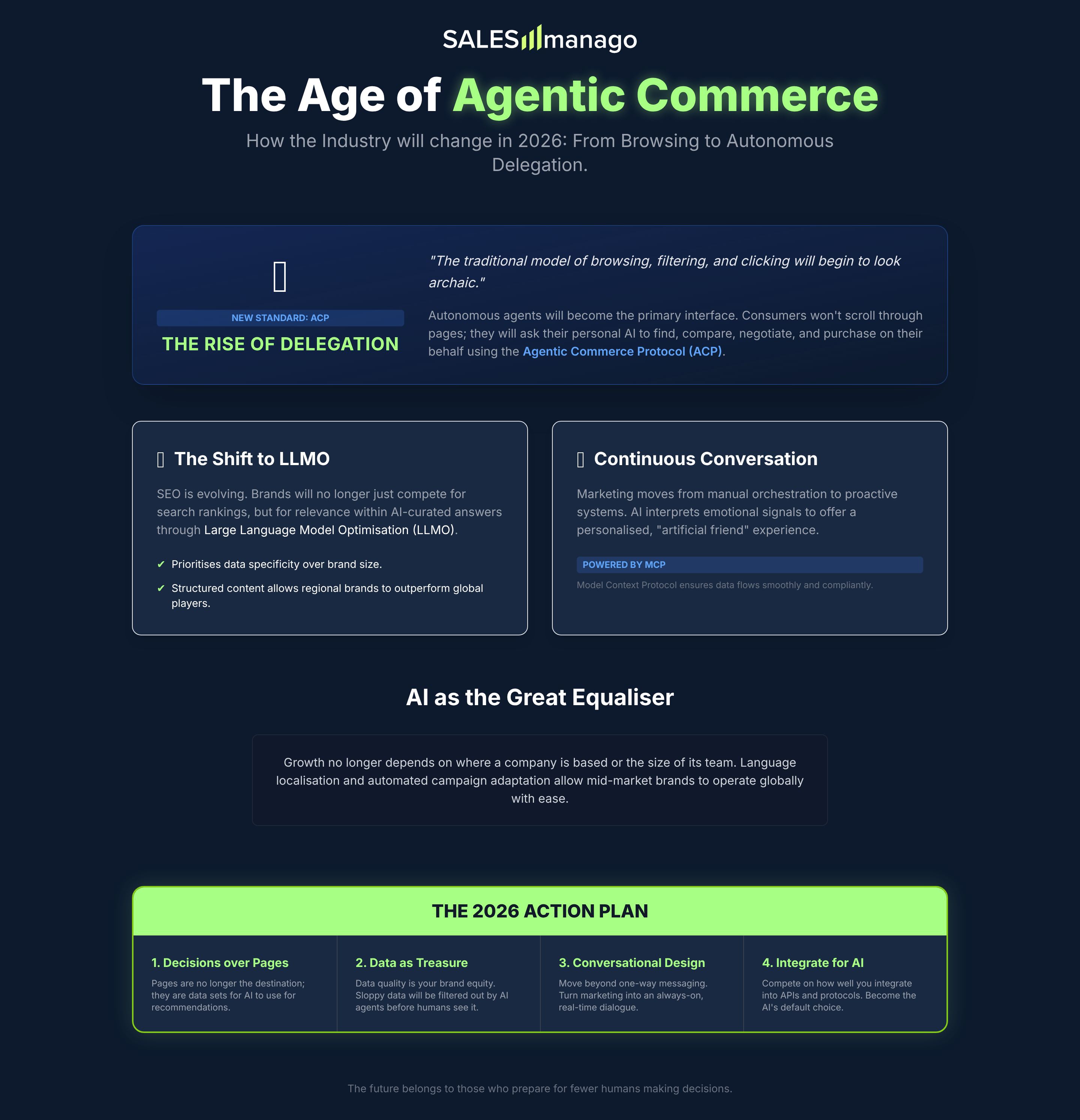
In a couple of years, the traditional eCommerce model of browsing, filtering, and clicking will begin to look archaic. In all probability it will be replaced by agentic AI, autonomous systems capable of understanding intent, context, and emotion, which will become a primary interface between consumers and brands.
We can already observe how the customer behaviour is evolving from active searching to delegation. We have started using AI “chats” more often for product recommendations, and thanks to early integrations, we can even buy them directly inside our conversations. But this is just the first step. The next one is asking AI "I need eco-friendly running shoes for wet conditions", and instead of scrolling through pages of results, our personal AI agent will find, compare, negotiate, and even purchase the best option on our behalf. Sounds like sci-fi? Well, five years ago ChatGPT sounded like sci-fi.
To make this happen, businesses need a major technology upgrade built on new standards like the Agentic Commerce Protocol (ACP).
This protocol allows AI agents representing both brands and consumers to validate and fulfill transactions seamlessly. Consequently, the traditional digital storefront will give way to a decentralised network where brands are discovered through AI-accessible data layers rather than visual web pages.
And this is just the beginning.
>> Interested in new trends? Discover 6 trends shaping the future of eCommerce in 2026.
As AI agents become the gatekeepers of discovery, the rules of visibility change. For decades marketers have had one fundamental engine of growth: Search Engine Optimisation (SEO). They built, along with Google’s search engine (and a company) an interconnected ecosystem that dominated the digital marketing landscape for years.
By 2026, this will be superseded, or perhaps better said—enriched, by Large Language Model Optimisation (LLMO) and Generative Engine Optimisation (GEO).
In this new landscape, product knowledge, inventory, and customer preferences must be organised for machine understanding. Brands will no longer compete for search rankings but for relevance within AI-curated answers. This change prioritises specificity and data quality over brand size. A focused regional brand with deep, structured content will be able to outperform a global player producing generic messaging, appearing directly in the answers provided by a consumer’s AI agent.
Don’t get me wrong. It won’t replace SEO. Not for a long time. If anything, it will make the fight for content optimisation even more fierce.
Agentic AI will change everything for one more reason. It brings back a feeling of connectivity. It is artificial, phantom-like, but somehow also real. Because customers actually speak to AI. And AI responds immediately.
Do you remember being a kid sent by your parents to a small neighbourhood grocery shop where you had been asking shop assistants for specific products or their prices. You don’t have this personal experience when scrolling through eCommerce stores. But you will have it with agentic AI. A conversation that will result in a personalised recommendation from your artificial friend.
For marketers, the rise of agentic capabilities means stepping back from manual orchestration. We are moving toward systems that act proactively rather than passively waiting for prompts. Marketing is evolving into a continuous conversation where campaigns optimise themselves in real-time.
To support this, MarTech stacks must integrate frameworks like the Model Context Protocol (MCP) to ensure data flows smoothly and compliantly between systems. This enables brands to establish real relationships by interpreting behavioural and emotional signals and offer a personalised experience. To become a real partner for our customers.
Perhaps the most profound impact of these shifts will be the democratisation of growth. Historically, market dominance was dictated by logistics, budget, and scale. But not anymore. AI is becoming a structural equaliser that gives everyone a new chance to shine.
For example, cross-border commerce will become easier for mid-market brands thanks to AI language localisation and automated campaign adaptation. This allows smaller companies to operate across multiple countries without the need for massive teams.
In 2026, growth will not depend on where a company is based but on how effectively it adapts to an AI-mediated market. The winners will be those who treat AI not just as a tool for efficiency but as the central engine for discovery, engagement, and trust.
Agentic commerce is not a trend to ignore for another year. It’s a structural change, and brands that treat it as “another AI wave” will miss their opportunity to find themselves in the centre of the customer's attention.
So, how to make the most out of this situation? Here’s how to stay visible in times when humans stop browsing themselves and start delegating to AI.
1. Focus on decisions not on page optimisations. Your product pages are no longer the destination for your customers but a set of data that AI will use or not for recommendation.
2. Treat your data like a treasure. In an agentic ecosystem data quality will become brand equity. Sloppy data will be filtered out by AI long before a human ever sees it.
3. Design for conversations, not campaigns. The era of one-way messaging is ending. Agentic AI turns marketing into an always-on dialogue where offers, tone, and timing adapt in real time. The winning brands won’t be louder but more relevant, more often.
4. Think beyond the shop owner mindset. In 2026, eCommerce brands won’t compete only on products but on how well they integrate into APIs, protocols, and AI. The question is “How do we become the default choice when an AI decides?”.
The future of eCommerce belongs to those who prepare not for more visitors but for fewer humans making decisions.



Google "what percentage of loyalty programs fail" and you'll get a wider range than the Andes (world’s longest mountain range for those of you who failed Geography). Depending where you read anywhere from 20% to 97%. That tells you two things. First, nobody really agrees on what "fail" even means. Second, quite a lot of loyalty programs aren&...
You’ve seen the slide before. You know the one with your brand in the middle, channels radiating outward like a proud little sun. Email, SMS, web push, social, paid ads, on-site personalisation, maybe a loyalty program if you're feeling ambitious. It says "
This month isn’t about being fooled by the next massive industry panic or buying into stressful, hyper-complex tech trends. Low-friction joy? Welcome to the era of Treatonomics.